Sound shapes more of your daily life than you realise. Every time you’re at a cinema or enjoying a quiet ride in a fast car, you’re experiencing the power of acoustical engineering at work. This field combines physics, technology, and mechanical engineering to control how sound moves, reflects, and is absorbed.
A Master of Science in Acoustic Engineering can elevate your fundamental engineering background into high-value expertise for high-demand careers. From tech giants to top design firms, businesses are desperate for master’s graduates who truly understand sound, making this a smart time to level up your degree.
If you’re ready to master wave mechanics, computational modelling, and advanced sound measurement to shape how the world hears, these MSc programmes at leading universities deserve serious consideration.
Source: University of Southampton
University of Southampton
Quieter aircraft cabins. Concert halls that carry a whisper to the back row. Surround sound audio. Ultrasound scanners, and sonar that maps the sea floor. These are just some of the applications of acoustical engineering, a field that spans mechanical, electrical, civil, environmental and biomedical engineering. One institution at the forefront of this field is the Institute of Sound and Vibration Research (ISVR) at the University of Southampton. Established over 60 years ago as the world’s first university institute devoted entirely to sound and vibration, ISVR continues to work across areas including aeroacoustics, underwater acoustics, structural vibration, active noise control, signal processing, acoustic metamaterials, spatial audio, building acoustics, human perception and structural health monitoring.
This wide range of expertise is reflected in the 12-month MSc in Acoustical and Vibration Engineering. Accredited by the Institution of Mechanical Engineers, the programme attracts students from around the world with backgrounds in mechanical engineering, electronics, physics, mathematics and music technology.
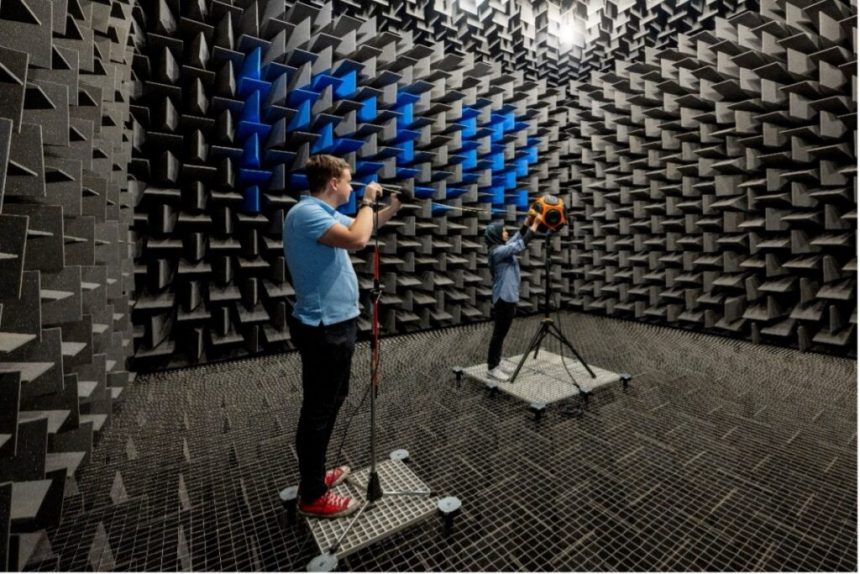
Through this programme, you’ll develop a strong understanding of the physical principles behind sound and vibration, then apply what you learn through hands-on laboratory sessions. State-of-the-art experimental facilities such as acoustic chambers, an underwater test facility, motion simulators, virtual acoustics labs and listening rooms are available to support your project work.
This practical experience can open doors to a range of careers after graduation. Each year, an acoustics careers fair brings 20-30 hiring companies onto campus, giving students the chance to connect with potential employers. Graduates go on to work in acoustic consultancies, automotive and aerospace manufacturing, and audio equipment suppliers, while others continue to PhD study and pursue academic careers.
For Deyu Fan, an MSc graduate, the programme provided an opportunity to turn classroom learning into research. “Studying at ISVR, University of Southampton has been a truly transformative year for me, both academically and personally,” he says. “The MSc gave me a solid foundation in acoustics and signal processing; under the guidance of my project supervisors, I learned to carry out precise sound-field measurements in the anechoic chamber and even published my first paper.”
For full entry requirements, fees and scholarship information, visit the course page, or email isvr@southampton.ac.uk for specific queries.

The MSc in Music and Acoustic Engineering at Politecnico di Milano combines acoustics, signal processing, computer engineering, and music technology. Source: Politecnico di Milano
Politecnico di Milano
Sound surrounds every part of daily life, from the concert hall to the phone in your pocket, yet few people ever learn how it’s built, shaped, or controlled. Politecnico di Milano‘s MS in Music and Acoustic Engineering trains students to do exactly that. The degree blends computer science with signal processing and acoustics into one demanding, hands-on programme.
Your first lays the foundation, then you choose a track. Pick Acoustic Engineering, and you’ll move to the Cremona campus, where your second year leans into how musical instruments vibrate and produce timbre, plus room acoustics and vibration in general. You’ll start with the fundamentals of acoustics, then work up through numerical modelling, vibroacoustics, musical acoustics, and room acoustics. By the end, you’re not just reading about acoustic problems, you’re solving them.
Your training happens inside top facilities. The Musical Acoustics Lab sits inside Cremona’s Palazzo dell’arte, home to the city’s famous Violin Museum. This means you’ll be working steps away from instrument makers and centuries of craft knowledge. You’ll run measurements in an eight-by-five-metre semi-anechoic rendering room built for timbral and spatial audio testing, and experiment with a fourth-order ambisonics dome of 32 speakers for immersive listening research.
That combination of engineering and craft carries into your career. You could end up designing musical instruments, working on high-end loudspeakers and PA systems, or moving into audio MEMS devices and vibro-acoustic sensors. Growing public concern over noise pollution is opening roles in acoustic surveys and building comfort design, too. Whichever direction you take, you’ll be applying technical precision to work that ultimately gets judged by ear.
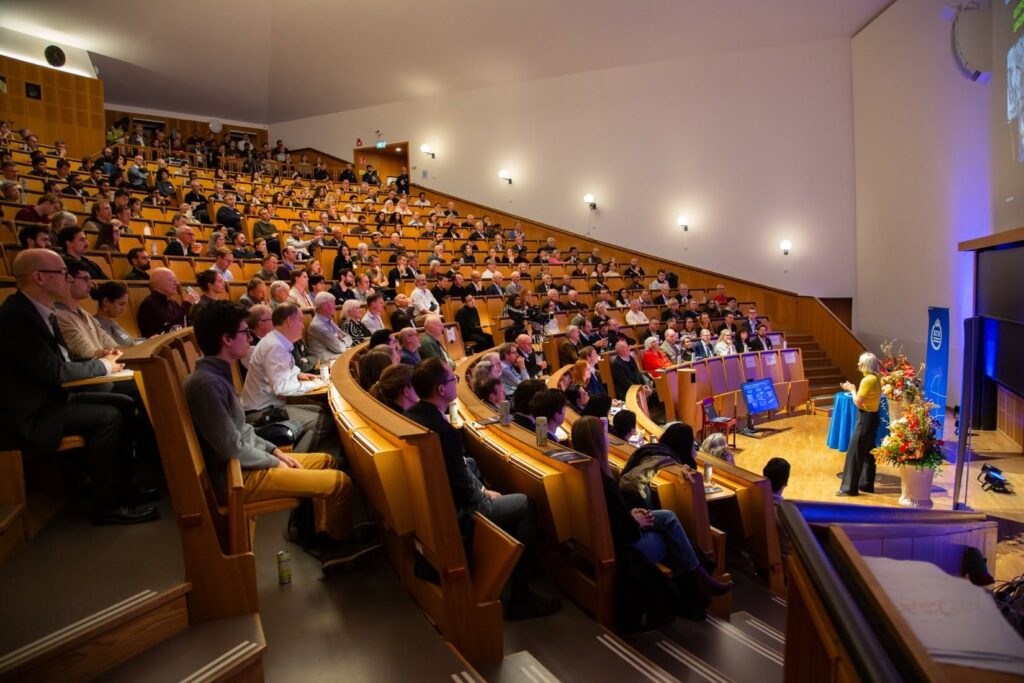
The Sound and Vibration track of the MSc Engineering Mechanics at KTH Royal Institute of Technology covers acoustics and vibration control, with opportunities for further specialisation. Source: KTH Royal Institute of Technology
KTH Royal Institute of Technology
Sound and vibration sit at the centre of how machines get built today, from a quiet electric car cabin to a wind turbine that won’t rattle apart. KTH Royal Institute of Technology‘s MSc in Engineering Mechanics lets you specialise in exactly that through its Sound and Vibration track, one of three tracks within the programme.
Your first three semesters mix theory with applied, project-based courses, so you’re never just sitting through lectures. You’ll work through continuum mechanics and finite element methods before moving into acoustics, vibro-acoustics, and flow acoustics, the core subjects that define this track. Only about a third of the courses are mandatory, which leaves you room to build a study plan around what actually interests you, whether that’s vehicle noise or building acoustics.
Once that foundation is in place, your fourth semester is entirely your own. You’ll spend five months on a degree project, often inside a company or research group, digging into one problem in real depth rather than skimming several.
But none of that depth will be possible without the right setup, and the facilities here will match the ambition. You’ll train inside the Marcus Wallenberg Laboratory for Sound and Vibration Research, the largest university centre in northern Europe for this kind of experimental work. Its four connected measurement rooms let you run sound power and absorption tests, then move into full modal analysis, while an on-site aero-acoustic test rig supports research into fan and fluid machinery noise.
The programme includes more experience and exposure that get you ready to join the industry fast. Expect to work alongside companies like Scania, a world-leading truck manufacturer, and Bombardier, a train and aircraft giant, throughout your coursework.

The MSc in Engineering Acoustics at the Technical University of Denmark combines theory with experimental work and practical engineering methods to solve complex sound-related challenges. Source: Technical University of Denmark
Technical University of Denmark
Traffic noise shapes how healthy a city feels. Music shapes how people feel in the moment. Sound sits at the centre of both, and Technical University of Denmark (DTU)’s MSc in Engineering Acoustics trains engineers to work at that intersection of physics, signal processing, and human hearing.
The two-year programme lets students build a study plan around real interests rather than a fixed track. Five specialisations are on offer. A student drawn to loudspeaker and microphone design works through electroacoustic systems and spatial sound. If you’re more interested in buildings, then you can move into structural acoustics and sound radiation. Someone chasing data-driven methods applies machine learning to audio analysis and modelling. Hearing science and architectural acoustics round out the remaining tracks, each drawing from a wide shared pool of courses.
None of this works without the right lab space, and DTU has built some of the best in the field. Its Anechoic Chamber at Lyngby Campus strips out every reflection, giving researchers a clean environment to test loudspeakers and observe how sound bends around objects. Right next door is the Audio Visual Immersion Lab, a cube-shaped space with four listening booths and 64 loudspeakers arranged in a sphere around the listener. It exists to study spatial hearing and multisensory perception, and nothing quite like it exists anywhere else.
That kind of training opens doors across the industry. Some graduates head into hearing aid development at companies like Oticon and GN ReSound, while others land transducer and measurement roles at Brüel & Kjær or audio engineering jobs at Bang & Olufsen. And for those who want to go further, the programme lays the groundwork to walk straight into PhD research, at DTU or anywhere else in the world.