
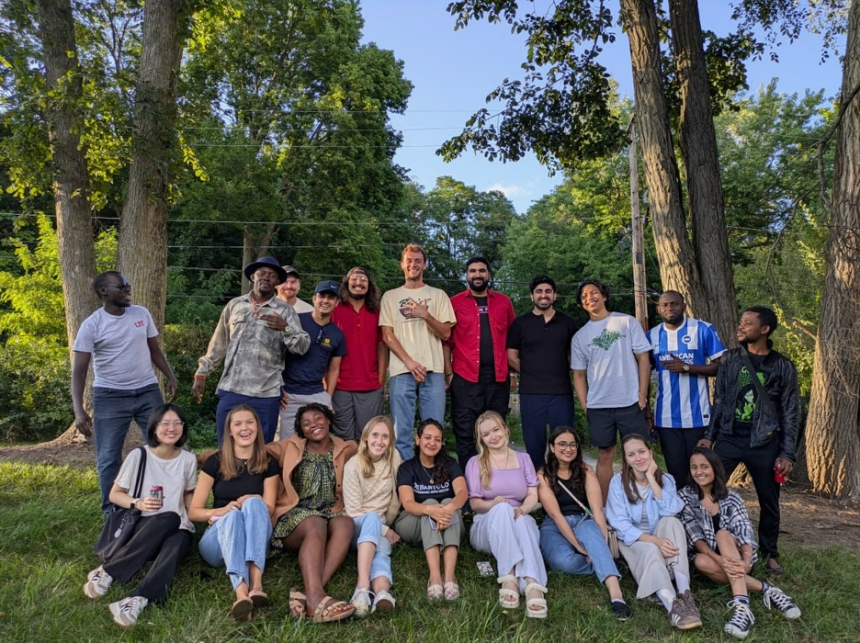
The Keough School of Global Affairs at the University of Notre Dame offers a Master of Global Affairs (MGA) that stands out for its combination of rigorous academics and real-world experience.The two-year programme includes immersive global fieldwork, with tuition fully funded for all students and field experience fully funded, as well as opportunities to work alongside policymakers, researchers, faith leaders and activists.
Students can also tailor their degree to their interests through one of three majors: Governance and Policy, International Peace Studies or Sustainable Development. Depending on your chosen major, you may explore areas such as policy analysis, quantitative methods, sustainable development, or conflict transformation.
But what does that experience actually look like? We spoke to a current student and a graduate about the academics, fieldwork, community and career preparation they experienced at Notre Dame. Jason William Soemantri is studying Governance and Policy while graduate Irakli Gabidzashvili chose Governance and Policy because it aligns with his public service career in his home country of Georgia.
Jason William Soemantri rates the programme around seven or eight out of 10 in terms of academic challenge. Source: University of Notre Dame
Jason William Soemantri, Master of Global Affairs, Governance and Policy
Can you tell us a bit about yourself? Where are you from, and what made you choose the University of Notre Dame’s Keough School of Global Affairs?
I was born and raised in Jakarta, Indonesia, and attended an English-speaking school. My parents both moved to the US for college, so I always imagined following a similar path. I moved to the US for my bachelor’s degree, starting at a community college in Washington State before transferring to the University of Washington, where I graduated with a degree in Political Science. After graduation, I spent a year doing political canvassing and civic education work before returning home.
Choosing the Keough School came from wanting to build on my broad undergraduate foundation in politics, policy, and foreign affairs while gaining more practical skills. After working and living back home, I developed a passion for urban policy and data analysis. The Global Affairs programme appealed to me because I could conduct real research through i-Lab, strengthen my quantitative skills through the Governance and Policy track, and build meaningful connections with professors.
With so many graduate degree options available, is a Master of Global Affairs still worth it in 2026?
Yes, it is still worth it. Critical thinking and policy analysis are increasingly valuable in a world where every sector, from environmental issues to civil rights and food security, is being affected. Personally, I’ve found a Master of Global Affairs beneficial because it has helped me develop practical skills in research, policy, project management, and data analysis that I did not gain during my undergraduate years. I’ve found that practical experience matters when preparing for the job market. Experiences such as i-Lab fieldwork, working as a research assistant, and developing skills in R or Stata have made me a stronger candidate while helping me explore my interests.
Why did you choose the governance and policy major and how did it fit with the kind of career you wanted after graduation?
I chose the Governance and Policy major because it felt closest to what I was looking for in public policy and seemed to provide the most freedom in terms of coursework and areas of focus. This allowed me to pursue my interest in urban policy, which does not fit as neatly into a Global Affairs programme compared with other topics.
Because I had already studied political science as an undergraduate, some of the courses felt familiar to me. However, I am still glad I chose the major for its emphasis on quantitative analysis and the ability to incorporate courses that align with my personal interests.
What was the field experience like on the ground and did it live up to what was promised?
The field experience absolutely lived up to my expectations and what was promised. I got very lucky to be on a team that I clicked really well with and that was very motivated and on the same page. It’s been incredibly fulfilling to interview people, travel to different places, and even do tedious work like coding and transcribing. You get a sense of how to work as a team, overcome setbacks, and readjust strategies. I’ve done some of that before, but never for something that lasted this long and involved this much work.
What surprised me was just how much value I found in the qualitative work of interviewing. I’ve always loved quantitative, data-driven analysis, but this project showed me the pitfalls and limitations of that and how practical field research can supplement it in tangible ways.
What is it like to live and study at Notre Dame as an international student?
The university has a beautiful campus. It has everything you could ever want or need from a college experience. The library is incredible, and it is where I spend most of my time. Everybody will talk about football, but the passion for collegiate athletics exists no matter the sport. South Bend itself is small but has a surprisingly vibrant downtown atmosphere. There’s enough to do outside of school, but there’s also so much to do on campus that you’re never without a place to be or a thing to do. The cost of living is very manageable relative to other college town areas, especially urban ones. Overall, it feels like a community that cares a lot about the school and its traditions, which is something I appreciate.
What do you wish you had known before starting the MGA program?
Don’t stress about having opportunities in place right when you get there. The research opportunities, the jobs, and the extra courses will be there. Getting them is easier than you think. The faculty and the programme want you to succeed and want to support your interests. It’s more about putting your best foot forward and showing you care and want to learn. In the meantime, lean on the cohort, who you’ll learn so much from, sometimes even more than the courses themselves.

Irakli Gabidzashvili from chose the Governance and Policy major because it aligns with his public service career and offers practical insight into policymaking and decision-making. Source: University of Notre Dame
Irakli Gabidzashvili, Master of Global Affairs, Governance and Policy
Can you tell us a bit about yourself? Where are you from, and what made you choose the University of Notre Dame’s Keough School of Global Affairs?
I am from Georgia. What drew me to the Keough School was the combination of academic learning, cultural understanding, and personal growth. I wanted a programme that would make my two years meaningful by exposing me to different cultures and ways of life, not just subject matter. Studying alongside classmates from around the world, while gaining hands-on experience through opportunities like the i-Lab, has made the programme richer than I imagined. For me, choosing the Keough School meant investing in both personal and professional development.
Why did you choose the governance and policy major and how did it fit with the kind of career you wanted after graduation?
I chose the Governance and Policy major, which aligns directly with my career in public service back in Georgia. I liked that the programme is hands-on and allows me to understand how policies shape people’s lives and what it takes to become a better policymaker or decision-maker. My hope is to keep pushing further into the tools and frameworks needed to improve lives through policy and practice, whether in the public, nonprofit, or private sector.
On a scale of 1 to 10, how challenging was the programme?
I would rate it at an 8. The challenge comes on two fronts: the academic side – quantitative coursework, IR theory – and the social side, since so much of the learning happens outside the classroom. Looking back, I wish I had researched Notre Dame itself more, not just the Keough School. I knew the school well, but the traditions and culture of the wider university were a wonderful surprise that I only discovered after arriving (though, in fairness, I picked it up fast – by the end of my first semester, I was fully Irish).
Does it really matter where you get your Master of Global Affairs?
Yes, it does. And I think that’s why prospective MGA students spend time weighing their admission offers. Keough is a school, but it’s also part of the much bigger Notre Dame family, and that’s a brand you carry for life. People reach out to you simply because you share Notre Dame in common. On top of that, the faculty members are genuinely accessible and come with networks that can connect you to the right people at the right time. Having access to their expertise and professional networks is one of the biggest advantages of studying here.
How diverse and global is the Master of Global Affairs cohort, and does that diversity enrich your learning?
After two years at Notre Dame, I can say with confidence that the MGA is the most diverse programme at Notre Dame, with more than 25 countries represented in my cohort alone. It is not just diversity of origin, but also diversity in everyday life. That shows up through conversations, teamwork, food, art, and the realisation that a policy that worked brilliantly in Georgia simply does not translate the same way elsewhere.
My favourite proof of how small this world gets: during fieldwork in Uganda over spring break 2026, I walked into a stakeholder interview and saw a lady who looked like somebody I knew. During the conversation, she mentioned that her daughter studied at Notre Dame, and it turned out she was my classmate Abiya’s mother. I had just found her in the middle of Uganda.
Follow the University of Notre Dame on Facebook, X, Instagram, LinkedIn, and YouTube
