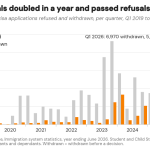
Japan hit its 2033 international student target eight years early.
As of June 2025, Japan was home to 435,200 international students, according to the Immigration Services Agency. The figure has already exceeded the government’s target of 400,000 international students by 2033, fueled by a record 180,000 first-time enrollments in a single year.
More students are choosing Japan over traditional study destinations, and the trend continues to grow.
It is easy to see why. Japan ranks first for safety from violent crime and first for transportation safety in Berkshire Hathaway Travel Protection’s 2026 safest countries ranking, holding a top-10 position every year since 2018.
It has 26 UNESCO World Heritage Sites, 539 Michelin-star restaurants, and a culture that has shaped music, design, food, and technology across the globe.
Some even come to study at English universities in Japan because of their love for anime.
The one thing that has always held them back is language. Japan ranks 96th out of 123 countries in the 2025 EF English Proficiency Index — its lowest position since the index launched in 2011.
Outside university campuses and major tourist areas, communicating in English can still be difficult.
Inside the classroom, though, things are changing. In 2025, the University of Tokyo’s Graduate School of Engineering announced that English would become the standard language of instruction for all classes from 2026. It is one of many Japanese universities expanding English-taught programmes to welcome more international students.
So, without further ado, let’s explore the top universities in Japan that offer English-taught programmes.
TL;DR? Here’s the summary:
- Ritsumeikan Asia Pacific University ranks first in Japan for international student ratio in QS World University Rankings 2026
- Tuition at most national universities ranges from US$3,300 to US$5,200 per year.
- This article lists the 14 best universities in Japan that offer English-taught programmes.
14 best English universities in Japan
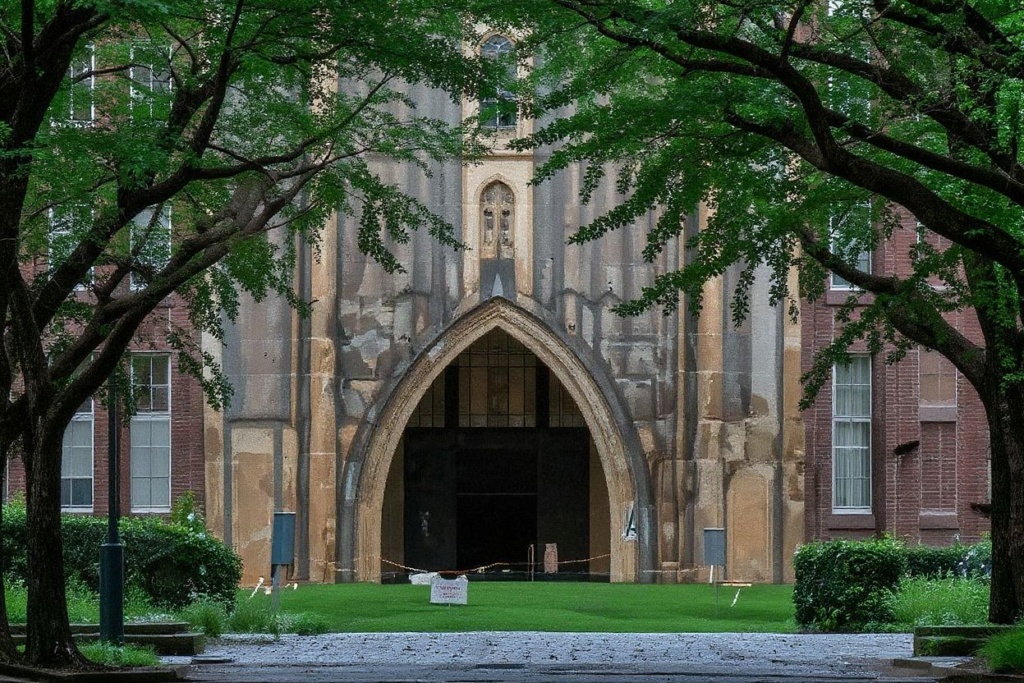
The University of Tokyo is the first national university in Japan.
1. University of Tokyo
Location: Tokyo
Fee: US$3,300 – US$5,200 per year
As the first national university in Japan, the University of Tokyo offers courses in essentially all academic disciplines you can think of at both undergraduate and graduate levels.
Almost two centuries old, the research university is known for being the most difficult to get accepted. In 2021, only 3,071 out of 9,356 undergraduate students made the cut, while postgraduate students experienced the same, with 3,323 out of 8,126 applicants succeeding in enrolling.
But do not let that discourage you from applying to the best university in Japan and one of the finest in Asia, especially when in April 2025, they announced their first new department — the College of Design — in almost 70 years. The bigger news? All lessons will be conducted in English.
Other English programmes available include:
- Environmental Sciences
- Economics
- Agricultural Development Studies
- Public Policy
2. Kyushu University
Location: Fukuoka
Fee: US$3,400 – US$5,200 per year
Often ranked among the top 10 best English universities in Japan, Kyushu University offers English-taught programmes ranging from humanities and arts to engineering and medical sciences.
Research is its strength as faculty members and students work together to tackle society’s most pressing issues, aiming to build a better Japan.
The university’s Ito Campus is one of the largest in the country, and it is expected that the university will gain more students, especially international ones, in the future.
English programmes here include:
- Introduction to Japanese Economy
- Technical Communication
- Bioethics
- Medical Dosimetry

Hokkaido University alumnus Akira Suzuki received a Nobel Prize in 2010.
3. Hokkaido University
Location: Hokkaido
Fee: US$3,400 – US$5,200 per year
Since its establishment in 1876, Hokkaido University has followed four basic philosophies in its educational system: Frontier Spirit, Global Perspectives, All-round Education, and Practical Learning. For years, the university has held onto these philosophies, producing leaders in respective industries.
Case in point: Akira Suzuki, who received a Nobel Prize in 2010 for his work on the cross-coupling reaction of organic boron compounds using palladium as a catalyst.
English programmes include:
- Chemistry
- Human Mechanical Systems and Design
- Cultural Studies
- Applied Bioscience
- Soft Matter
4. Institute of Science Tokyo
Location: Tokyo
Fee: US$4,070 per year
Notably, the youngest of the universities on this list, the Institute of Science Tokyo, is on a mission to advance science and human well-being and create value for and with society.
Following the merger between Tokyo Medical and Dental University and Tokyo Institute of Technology in 2024, the university provides the best education in the fields of humanities and social sciences from two leading institutions in the city combined into one.
It is here where you will build the future by conducting impactful research to solve worldly issues and collaborate with local communities to cater to their needs. From developing a competition platform where participants compete to develop large-scale AI to holding an interactive event using a glider simulator owned and built by the student club — anything is possible at the university.
English programmes include:
- Life Science and Technology
- Human-Centred Science and Biomedical Engineering
- Materials Science and Engineering
- Energy Science and Informatics
5. University of Tsukuba
Location: Ibaraki
Fee: US$3,400 per year
The University of Tsukuba aims to break how Japanese universities tend to operate formerly. What this means is they seek to create a flexible education and research structure as well as a university system to meet the needs of the next generation.
It is so much so that it is a Designated National University — one of the 10 Japanese universities that have shown the highest level of education and research capabilities. Having the university based in the city of Tsukuba, is an advantage too — here, over 200 private research organisations and approximately 60 public research organisations call Tsukuba home.
Better yet, international students pay domestic fees, so it’s no wonder that the university has approximately 7,500 international students pursuing their degrees here.
English programmes include:
- Global Issues
- International Social Studies
- Public Health
- Mountain Studies
One of the best English universities in Japan is Keio University, which offers over 900 classes taught in English.
6. Keio University
Location: Tokyo
Fee: US$5,900 – US$22,400 per year
When everybody adhered to Confucian ideals in 19th-century Japan, where learning was centred around the religio-philosophical, Keio University founder Yukichi Fukuzawa went against the norm. This resulted in the “jitsugaku“ motto, a way of learning about the world through the application of reason, observation, and verification — in other words, learning through empirical science.
There are 974 classes in English, making it not only accessible to students from abroad but also fostering an awareness of globalism among locals.
English programmes include:
- Taxation Policy and Management
- Robotics
- Economics
- Medicine
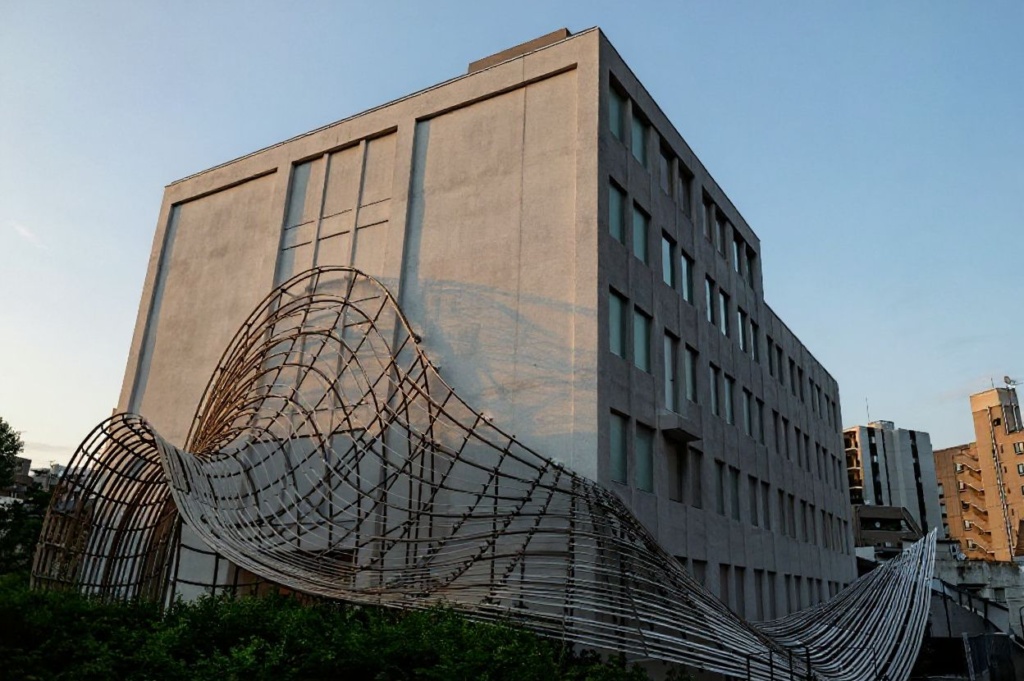
Waseda University is where nine Japanese Prime Ministers were shaped.
7. Waseda University
Location: Tokyo
Fee: US$6,400 – US$9,300 per year
Waseda University is regarded as one of the most prestigious universities in Japan, particularly for its humanities and social sciences education. Here, nine Japanese Prime Ministers sought their education, with Yoshihiko Noda being their latest alumnus to become the country’s leader.
It is also dubbed the most international university in the country, with 8,084 students from around the world pursuing their studies in the university’s halls.
English programmes include:
- Mathematical Sciences
- Global Political Economy
- Sport Management
- International Relations
8. Rikkyo University
Location: Tokyo
Fee: US$3,800 – US$6,100 per year
Also known as Saint Paul’s University, Rikkyo University provides education based on Christian values, following its origins of teaching bible studies and English back when it started in 1874.
Today, it is part of the Top Global University Project, a government initiative to internationalise universities in the country by bringing in more international students, expanding its network of global partners, and increasing the ratio of international staff members to 1:5.
English programmes include:
- Global Liberal Arts
- Law
- International Business
- Social Development and Administration
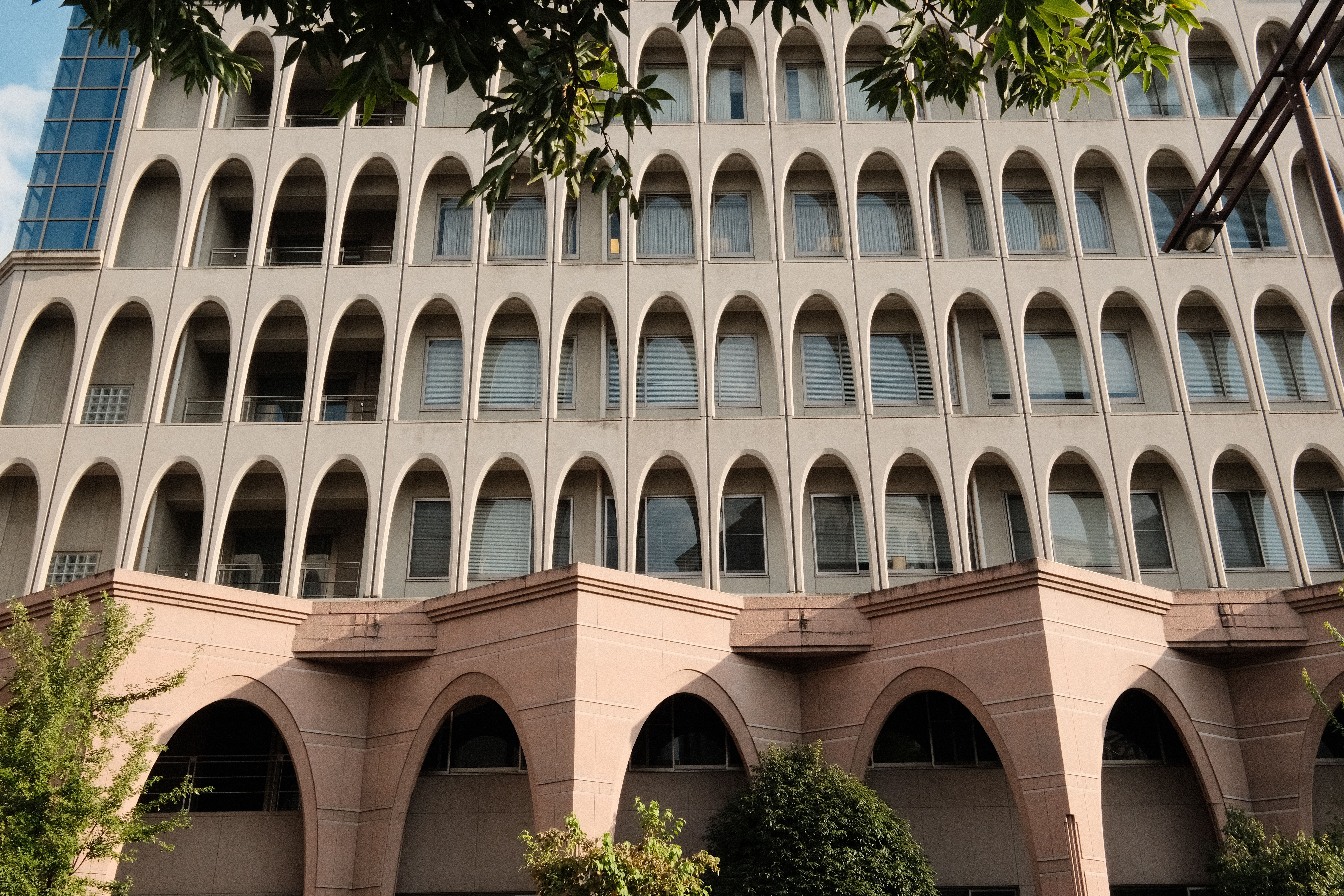
Nagoya University has produced four Nobel laureates from its faculty and alumni. Source: Pexels
9. Nagoya University
Location: Nagoya, Aichi Prefecture
Fee: US$3,314 per year
Nagoya University‘s G30 International Programmes offer 10 undergraduate and 30 graduate degree programmes taught entirely in English, with no Japanese language requirement at the time of enrolment.
Running since 2011, the G30 is one of Japan’s longest-established English-taught degree frameworks, spanning engineering, science, medicine, economics, and the humanities. The university charges international students the same tuition as domestic students — no surcharge.
Nagoya sits in Japan’s industrial heartland, home to Toyota, Denso, and a concentration of manufacturing and technology companies that gives engineering and science students direct proximity to real-world R&D.
English programmes include:
- Automotive Engineering
- Physics
- Chemistry
- Biological Science
10. Ritsumeikan University
Location: Kyoto
Fee: US$5,400 – US$16,000 per semester
If you’re all about sustainability, Ritsumeikan University is the place to be. Here, they incorporate the United Nations’s Sustainable Development Goals in each of its programmes taught.
You might work with Associate Professor Tomoko Hasegawa, who is resolving hunger issues caused by climate change, or Professor Motoki Kubo, who is studying microorganisms to revamp Japanese agriculture. Whichever programme you enrol in, achieving sustainability is always the priority.
English programmes include:
- Global Studies
- Community and Regional Policy Studies
- Information Systems Science and Engineering
11. University of Osaka
Location: Osaka
Fee: US$3,315.50 per year
One of Japan’s former Imperial Universities, the University of Osaka was selected for the Japanese government’s Global 30 Project in 2009 — a national initiative to build core universities for internationalisation.
Under that framework, the university set up undergraduate degree programmes conducted entirely in English, allowing students to attend and graduate without any Japanese language requirement.
Founded in 1931, Osaka is consistently ranked among Japan’s top three research universities and sits in Japan’s second-largest city, giving students direct access to one of Asia’s most dynamic commercial and cultural centres.
English programmes include:
- Human Sciences
- International Undergraduate Programme in Science

Public transport in Japan runs on time, every time. For students still finding their footing in a new country, that is one less thing to worry about. Source: Pexels
12. Akita International University
Location: Akita City, Akita Prefecture
Fee: US$5,542 per year
Akita International University is unique in Japan for offering an International Liberal Arts education entirely in English — the first undergraduate programme in the country to do so.
The university is clear about what that means: “All lectures are given in English. However, our institution is not a university to study English. It is a university to study and think in English.”
All content courses are taught in English, and all students are required to complete a one-year study abroad programme before graduating. One in four students on campus is an international student, drawn from over 200 partner universities across 51 countries and regions.
English programmes include:
- Global Studies
- Global Business
- Global Connectivity
13. Ritsumeikan Asia Pacific University
Location: Beppu, Oita Prefecture
Fee: US$9,000 in year one; US$10,237 per year from year two
Ritsumeikan Asia Pacific University (APU) sits in Beppu City in southern Kyushu, where students from over 111 countries and regions study side by side in a nearly one-to-one ratio of domestic Japanese to international students.
Courses are offered in both English and Japanese, so you can complete your entire bachelor’s degree in English. That international mix shapes how learning actually happens on campus. The university’s motto, “Shape your world“, reflects a mission to develop graduates who actively find solutions to global issues and leave equipped to work anywhere.
APU ranks first in Japan for international student ratio in the QS World University Rankings 2026 and is the only Japanese university to hold AACSB accreditation for undergraduate business education in both English and Japanese.
English programmes include:
- Asia Pacific Studies
- International Management
- Sustainability and Tourism
14. Tohoku University
Location: Sendai, Miyagi Prefecture
Fee: US$3,314 per year
One of Japan’s former Imperial Universities, Tohoku University offers several undergraduate degrees taught entirely in English through its Faculty of Science, School of Engineering, and Faculty of Agriculture.
A new English-taught undergraduate programme — Gateway College — launches in 2027, offering an interdisciplinary curriculum that lets students explore multiple academic fields before choosing a specialisation.
In February 2026, MEXT exempted Tohoku from enrolment caps, allowing it to take more international students in specific programmes for the 2026 intake.
English programmes include:
- Molecular Chemistry
- Mechanical and Aerospace Engineering
- Marine Biology
At a glance: 14 best universities in Japan that offer English-taught programmes
| University | English programmes |
| University of Tokyo | Environmental Sciences, Economics, Agricultural Development Studies, Public Policy |
| Kyushu University | Introduction to Japanese Economy, Technical Communication, Bioethics, Medical Dosimetry |
| Hokkaido University | Chemistry, Human Mechanical Systems and Design, Cultural Studies, Applied Bioscience, Soft Matter |
| Institute of Science Tokyo | Life Science and Technology, Human-Centred Science and Biomedical Engineering |
| University of Tsukuba | Global Issues, International Social Studies, Public Health, Mountain Studies |
| Keio University | Taxation Policy and Management, Robotics, Economics, Medicine |
| Waseda University | Mathematical Sciences, Global Political Economy, Sport Management |
| Rikkyo University | Global Liberal Arts, Law, International Business, Social Development and Administration |
| Nagoya University | Automotive Engineering, Physics, Chemistry, Biological Science |
| Ritsumeikan University | Global Studies, Community and Regional Policy Studies, Information Systems Science and Engineering |
| University of Osaka | Human Sciences, International Undergraduate Programme in Science |
| Akita International University | Global Studies, Global Business, Global Connectivity |
| Ritsumeikan Asia Pacific University | Asia Pacific Studies, International Management, Sustainability and Tourism |
| Tohoku University | Molecular Chemistry, Mechanical and Aerospace Engineering, Marine Biology |
Frequently asked questions (FAQ)
Can I study in Japan if I don’t speak Japanese?
Yes. Several universities in Japan offer degree programmes taught entirely in English, including the University of Tokyo, Nagoya University, and Akita International University. You can attend and graduate without any Japanese language requirement.
Are English-taught programmes in Japan cheaper than studying in the US, UK, or Australia?
Yes. National universities in Japan charge around ¥535,800 (US$3,317) per year — the same for international and domestic students. By comparison, international students in the UK pay £15,000 (US$19,866)–£38,000 (US$50,329)per year, and in Australia, AUD $20,000 (US$13,916) –$50,000 (US$34,791).
Will a degree from a Japanese university be recognised by employers outside Japan?
Yes, particularly from research-intensive institutions like the University of Tokyo, Osaka, Tohoku, and Nagoya — all of which rank in the QS World University Rankings 2027 top 200. Employers in Asia, Europe, and North America recognise degrees from these universities.
Disclaimer: This article was last updated on June 23, 2026.