If you’re considering a graduate engineering degree, you’ll want to know how it can strengthen your career prospects. The University of South Carolina (USC)’s Molinaroli College of Engineering and Computing (MCEC) offers a range of graduate programmes, with its engineering school ranked No. 83 nationally in the 2025 US News Best Engineering Schools rankings. Here, students can pursue advanced study across fields including aerospace, chemical, civil, computer science, mechanical engineering, and more.
Whichever programme you choose, you’ll have opportunities to tackle complex engineering problems and apply what you learn in practical settings while developing specialised skills in your chosen field. It’s little surprise, then, that MCEC reports a 100% graduate career placement rate, reflecting the professional opportunities available to its graduates.
But what does that experience look like in practice, and where could it take you after graduation? We spoke to Master of Science in Mechanical Engineering graduate Ilana Lu to give you a closer look.
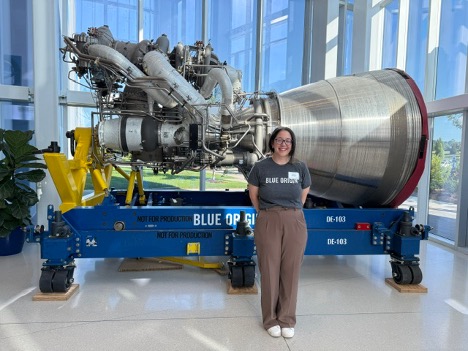
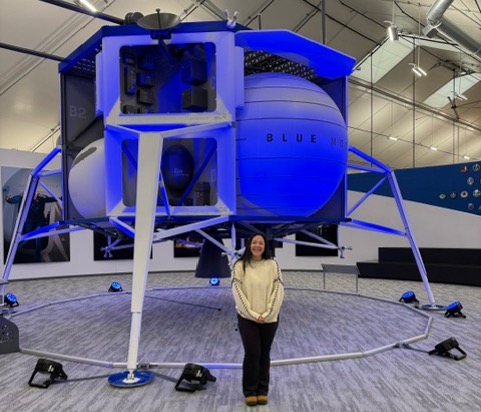
Lu completed her Bachelor of Science in Mechanical Engineering at USC before continuing with an MS in the same field. During her master’s, she completed a co-op with GKN Aerospace at Oak Ridge National Laboratory, working on friction stir welding and additive manufacturing. Her research and co-op experience helped launch her career in advanced manufacturing. She joined Blue Origin in 2019, worked at NASA’s Marshall Space Flight Centre until 2025, and has since returned to Blue Origin’s Engines business unit, where she supports production welding and large-scale additive manufacturing.
The University of South Carolina’s Molinaroli College of Engineering and Computing tackles today’s biggest challenges, empowering students to innovate, lead and shape the future. Source: University of South Carolina.
Ilana Lu, MS in Mechanical Engineering
Did you complete any internship or placement during the programme? If yes, please describe your responsibilities and how they related to your programme.
Yes. During my master’s programme, I spent six months on a co-op with GKN Aerospace at Oak Ridge National Laboratory in Tennessee. The research I carried from my undergraduate studies into the master’s programme at USC and then into the co-op focused on friction stir welding and additive manufacturing. My experience in both areas directly contributed to my success during the co-op.
I was fortunate to work on the development of both laser-wire directed energy deposition (LW-DED) and friction stir welding for aerostructure applications. Both areas were directly applicable to my master’s programme and ultimately helped prepare me for my career in the industry.
Is a master’s degree in mechanical engineering worth it?
Yes, I believe that a master’s degree in mechanical engineering is worth it, as it is flexible enough to benefit many different career paths while also giving you extra technical depth that a bachelor’s programme does not provide. It’s the sweet spot between the breadth of an undergraduate programme and the depth associated with a doctoral programme.
How difficult is USC’s master’s mechanical engineering programme?
It was a difficult programme, but not impossible. I found the courses to be challenging, but I was able to find success by studying both solo and in groups, as well as attending office hours. The biggest impact on my success was continuing to humbly ask questions when things were unclear and pushing myself to understand the material at a fundamental level. The biggest support system while I was there was the other students in the programme, as we were able to collaborate on each other’s research based on our specialities and skill sets, offer guidance for classes, and provide general camaraderie.
What are your impressions of the current job market for mechanical engineering master’s graduates?
I personally think the job market is quite strong for those with a master’s degree in mechanical engineering, especially in the US. When I’ve talked to recruiters or prospective employers in the past, it has never been a disadvantage, and I don’t feel that job offers have been significantly below the threshold I was expecting or comfortable with. The team I am on now within the aerospace industry has only hired new graduates with master’s degrees in various subjects over the last couple of years. Very rarely, but it happens, some companies will not count your master’s degree toward years of experience, but they typically still compensate fairly.
Is it worth specialising more during your master’s mechanical engineering studies (eg. in the direction of energy, automation, digitalisation, medical technology, etc.)?
Yes, and it can be intimidating to try to predict what your professional interests are before you’ve had industry experience. However, from a hiring and development perspective, candidates who have specialised in particular areas are more likely to be picked to continue similar work due to their familiarity and experience in these areas.
My recommendation is to select a specialisation that you have an interest in and want to grow further in so that you feel more connected to your work. For example, I was a welder before I went back to school for my bachelor’s and master’s degree programmes. Once I started research at the university, I chose welding-related research and adjacent fields like additive manufacturing and materials. All the coursework and thesis research that I did during this time ended up complementing my existing welding skill set and propelled me into advanced manufacturing within the aerospace industry, where I have now worked as a welding and additive manufacturing engineer for over seven years since graduation.
The Molinaroli College of Engineering and Computing offers graduate programmes for career advancement or academic research, with access to modern facilities and experienced faculty. Source: University of South Carolina
What kind of jobs can someone with a master’s in mechanical engineering get?
From my observations, the flexibility of jobs for someone with a master’s in mechanical engineering is broad. Once you’re hired into a position, very rarely is your academic experience factored into your day-to-day role, but it does help place you in a higher initial role and provide technical depth that other candidates may lack. So, it’s a quiet benefit to your toolkit that doesn’t hold you to any particular path.
Within the industry, there’s a blend of everyone from bachelor’s degree holders to doctorate holders, and they’re nearly indistinguishable in terms of day-to-day performance. However, the degrees do help when you’re applying for positions and competing with other candidates. I’ve stayed on a technical path within welding and additive manufacturing, but have also performed work in programme and project management, and could easily change career paths to design, factory operations, or production manufacturing engineering if there was a need.
Should I pursue a master’s degree if I can’t find a job after graduating with a BS in Mechanical Engineering?
Yes, I think it’s worthwhile for the right programme and specialisation, especially if finding an immediate job is proving difficult. The hiring industry appears to be ever more competitive, and many companies are starting to do stacked-rank performance reviews, so you want to set yourself apart with an invaluable technical skill set. There are many fields adjacent to or within mechanical engineering, like cryogenic fuel management, robotics, machine learning, computational materials engineering, thermal analysis, power generation, coatings, etc., where you can find mechanical engineering programmes and research topics that are industry-relevant.
What are you doing after graduating with a master’s in mechanical engineering, and what suggestions do you give to your juniors?
Currently, I am a Materials and Process Engineer supporting production welding for Blue Origin Engines, as well as leading the development of large-scale additive manufacturing (AM) for spaceflight hardware. What this means day to day is a mix of emergent production issues that require quick root cause analysis, intuition, and the technical backing to make immediate resolutions, as well as supporting design decisions and other internal customers. The other half of my role is more business development and strategy surrounding large-scale AM and the roadmaps and activities to manifest ideas into physical hardware.
The research, courses, co-op, and all other work experience have directly solidified my technical career, which led me to work at NASA Marshall Space Flight Centre prior to my current role. The mechanical engineering degrees I have were broad enough to enable flexibility in career choices, and I do feel they have been a benefit to my skills and career path.
I’m mid-career now, and in the near future, I need to decide if I want to continue to deepen my technical skills, pursue management, or pursue programme management. The advice I can give to new grads and prospective students is the quote, “stay humble, stay hungry,” to emphasise staying grounded while still reaching for technical excellence. I’ve found that intuition goes a long way, so also trust your instincts, which are guided by your experiences within your programmes and internships. Also, find good mentors at every point in your career.
Follow USC Molinaroli College of Engineering and Computing on Facebook, Instagram, LinkedIn and YouTube