

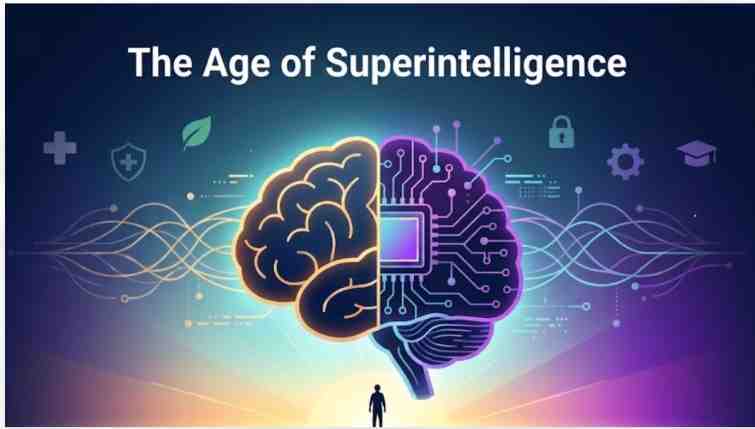
Beyond Artificial Intelligence: Understanding AI, AGI and Superintelligence
Artificial Intelligence (AI) is transforming how people work, communicate, conduct research and solve complex problems. From intelligent chatbots and autonomous vehicles to medical discoveries and space exploration, machines are becoming increasingly capable of performing tasks once associated with human intelligence.
But how far can this technology go? Could machines eventually become as intelligent as humans, or even surpass human capabilities?
These questions have brought two important concepts into the spotlight: Artificial General Intelligence (AGI) and Artificial Superintelligence (ASI). While today’s AI systems can perform impressive tasks, superintelligence describes a hypothetical future in which machines could outperform even the most capable human experts across fields such as science, mathematics, engineering and strategic decision-making.
To understand this possibility, it is important to first understand how Artificial Intelligence, Machine Learning, Deep Learning and Generative AI work. We also need to explore how AGI differs from superintelligence and why technologies such as quantum computing, robotics and biotechnology could play an important role in shaping the future.
In this guide, we break down these concepts in simple terms, explain how they are connected and examine what advanced technology could mean for humanity.
1. What is Artificial Intelligence?
Artificial Intelligence (AI) is the field of computer science concerned with developing machines and software that can perform tasks associated with human intelligence.
These tasks include:
- Understanding language.
- Recognising images and objects.
- Learning from information.
- Solving complex problems.
- Making predictions.
- Supporting decisions.
- Generating text, images, audio and video.
For example, when you ask an AI assistant to explain a scientific concept, it processes your question, uses patterns learned during training and generates a response.
AI does not necessarily think or understand in exactly the same way as a human. It processes information using mathematical models, algorithms and computational systems.
The US legal definition cited in the NASA material, 15 U.S.C. § 9401(3), describes AI as a machine-based system that can make predictions, recommendations or decisions based on human-defined objectives. This is a useful working definition, although AI is a broader and evolving field.
2. What is Machine Learning?
Machine Learning (ML) is a branch of Artificial Intelligence.
Traditional computer programs generally follow instructions explicitly written by programmers. Machine learning takes a different approach: instead of manually programming every possible situation, developers train a model using data so that it can identify patterns and make predictions.
Consider an example.
Imagine giving a computer 100,000 photographs of cats and dogs. Each photograph is labelled with the correct animal.
During training, the machine learning model analyses the images and identifies patterns associated with cats and dogs.
After training, it can receive a new photograph and estimate whether it contains a cat or a dog.
The important difference is that the programmer does not need to manually write every visual characteristic of every animal.
Common applications of machine learning:
- Fraud detection in banking.
- Credit-risk assessment.
- Weather forecasting.
- Predicting equipment failures.
- Recommendation systems.
- Identifying unusual patterns in medical data.
Machine learning can also work with relatively small datasets and structured information. Not every machine learning system requires a massive neural network.
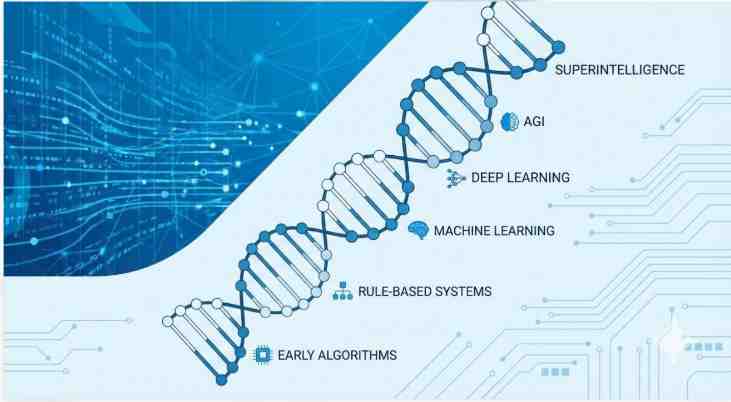
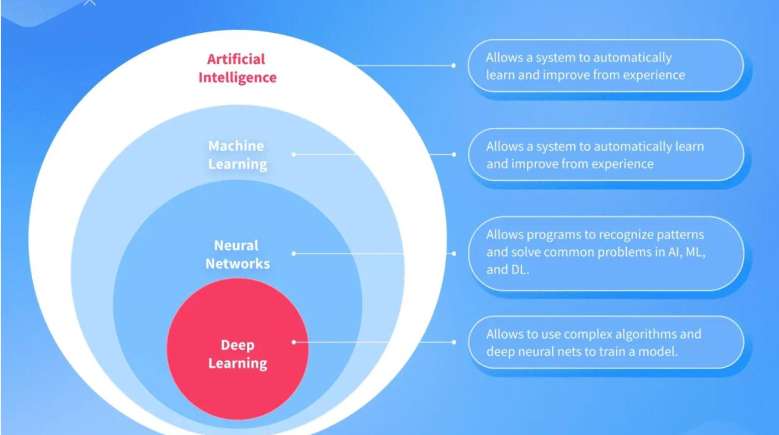
To understand how these technologies connect, it helps to look at the bigger picture. Artificial intelligence is the broader field, while machine learning and deep learning are specialised approaches within it. Generative AI builds on these techniques, whereas AGI and ASI describe broader or hypothetical levels of intelligence.
3. What is Deep Learning?
Deep Learning (DL) is a specialised subset of Machine Learning.
It uses artificial neural networks containing multiple processing layers to learn increasingly complex patterns from data.
The concept is loosely inspired by the interconnected structure of the human brain, although artificial neural networks are fundamentally different from biological brains.
For example, when a deep learning system analyses a photograph, different layers may learn to recognise:
- Basic visual patterns, such as edges and lines.
- More complex shapes and textures.
- Objects, faces and other meaningful features.
- Relationships between different elements in the image.
Deep learning is particularly useful for processing large and complex datasets.
Examples include:
- Facial and image recognition.
- Speech recognition.
- Medical image analysis.
- Autonomous driving systems.
- Advanced language models.
- Image, audio and video generation.
Deep learning has played a major role in the recent development of generative AI.
4. What is Generative AI?
Generative AI is a category of AI systems that can create new content based on patterns learned from existing data.
Instead of only classifying information or making predictions, these systems can generate:
- Written articles and reports.
- Computer programming code.
- Images and illustrations.
- Music and audio.
- Videos and animations.
- Synthetic data.
For example, a generative AI model can receive a written instruction and create an image that matches the description.
Large language models (LLMs) are another example. They are trained to process and generate human language by learning statistical patterns and relationships in large collections of text and other data.
Generative AI is not necessarily a separate intelligence beyond deep learning. Many modern generative AI systems are built using deep learning architectures.
5. What is Artificial General Intelligence (AGI)?
Artificial General Intelligence (AGI) refers to a proposed form of AI that could perform a broad range of intellectual tasks at a level comparable to human capabilities.
Most existing AI systems are specialised or have limitations, even when they can perform many different tasks.
For example, one AI system may be particularly effective at generating text, another at recognising medical images and another at predicting financial trends.
AGI would ideally be able to transfer knowledge between different areas, learn unfamiliar tasks, adapt to new environments and solve problems without requiring a separate specialised system for every task.
Imagine a machine that could:
- Learn civil engineering principles.
- Understand economics.
- Design a computer program.
- Conduct scientific research.
- Learn a completely unfamiliar subject.
- Apply knowledge from one field to solve problems in another.
It would not need to be independently trained from scratch for every new activity.
However, there is no universally accepted test or definition of AGI, and its arrival remains a subject of scientific and technological debate.
6. What is Artificial Superintelligence (ASI)?
Artificial Superintelligence (ASI), commonly called superintelligence, describes a hypothetical form of machine intelligence that would significantly exceed human intellectual capabilities across a wide range of important fields.
It would not simply be a faster chatbot or a more advanced computer program.
A superintelligent system could potentially outperform the best human experts in areas such as:
- Scientific discovery.
- Mathematics and complex reasoning.
- Engineering and technological development.
- Strategic planning.
- Medical research.
- Economic modelling.
- Solving problems that humans currently struggle to understand.
Imagine a system capable of analysing millions of scientific possibilities, identifying previously unknown relationships and developing solutions to problems that would take human researchers decades to investigate.
That is the kind of capability people are referring to when discussing superintelligence.
However, it is important to understand that ASI has not been demonstrated. It remains a theoretical possibility, and there is no established timeline for its development.
7. Understanding the differences
| Technology | Main purpose | Example |
|---|---|---|
| Artificial Intelligence | Machines performing intelligent tasks | An AI assistant |
| Machine Learning | Learning patterns from data | Fraud detection |
| Deep Learning | Learning complex patterns through multilayer neural networks | Image recognition |
| Generative AI | Creating new content | AI-generated images |
| AGI | Broad, general-purpose intelligence | A hypothetical human-level general AI |
| ASI | Intelligence substantially beyond human capabilities | A hypothetical superintelligent system |
An important distinction: AI, ML and DL describe technological fields and methods, whereas AGI and ASI describe proposed levels of general intellectual capability.
8. How does NASA use AI?
AI is useful in space exploration because space missions generate enormous quantities of information and often operate in environments where immediate human intervention is impossible.
NASA uses AI and machine learning in research and mission operations, including:
Autonomous systems: Intelligent software can help spacecraft and robotic systems respond to changing conditions.
Scientific data analysis: Machine learning can identify patterns in astronomical observations and large scientific datasets.
Robotics: AI techniques can support robotic exploration, navigation and decision-making.
Earth observation: AI can help analyse satellite imagery to identify environmental changes, monitor weather-related events and study the Earth’s surface.
Mission planning: Computational models can support complex planning and operational decisions.
One important clarification: NASA’s general AI material discusses artificial intelligence and machine learning. Its use of AI does not mean NASA has developed or deployed artificial superintelligence.
9. What technologies exist beyond AI?
AI is powerful, but it is not the only advanced technology shaping the future.
Several other fields can operate independently, support AI or combine with it.
Quantum computing
Quantum computing uses principles of quantum mechanics to process information differently from conventional computers.
Traditional computers use bits represented by 0 and 1. Quantum computers use quantum bits, or qubits, which can exploit quantum phenomena such as superposition and entanglement.
Potential applications include:
- Simulating complex molecules.
- Studying new materials.
- Investigating certain optimisation problems.
- Advancing scientific research.
Quantum computing is not automatically more powerful than conventional computing for every task, and practical quantum systems still face significant technical challenges.
Robotics
Robotics combines mechanical engineering, electronics, control systems, sensors and software to build machines that interact with the physical world.
Examples include industrial robots, surgical robots, autonomous vehicles and planetary exploration robots.
Robots can operate without advanced AI. A simple industrial robot may follow predetermined instructions, while an advanced robot can use AI to recognise objects and adapt to changing conditions.
High-performance computing
High-performance computing (HPC) uses powerful computer systems working together to solve computationally demanding problems.
It is used for:
- Weather and climate simulations.
- Nuclear and particle physics.
- Engineering simulations.
- Drug discovery.
- Large-scale scientific calculations.
HPC can run conventional scientific software, AI models or a combination of both.
Biotechnology and synthetic biology
Biotechnology uses biological systems and organisms to develop useful products and processes.
Synthetic biology takes this further by applying engineering principles to design or modify biological systems.
Potential applications include:
- Developing new medicines.
- Engineering microorganisms.
- Improving agricultural production.
- Developing advanced materials.
- Studying genetic diseases.
Brain-computer interfaces
Brain-computer interfaces (BCIs) create communication pathways between the brain and external devices.
They could potentially help people with paralysis control computers, communicate or operate assistive technologies.
This field combines neuroscience, electronics, signal processing and sometimes AI.
Advanced materials and nanotechnology
These fields involve designing and manipulating materials at very small scales or developing materials with specialised properties.
Potential applications include stronger construction materials, improved batteries, advanced electronics, medical devices and more efficient energy systems.
10. Which is more powerful: AI or technologies beyond AI?
There is no universal answer because these technologies solve different problems.
Consider the following:
- AI is useful for recognising patterns, making predictions and supporting intelligent decisions.
- Quantum computing may help solve particular computational problems that are difficult for classical computers.
- Robotics enables machines to perform physical activities.
- Biotechnology works with living systems.
- High-performance computing handles enormous computational workloads.
- Brain-computer interfaces connect biological neural activity with external devices.
The most significant advances may come from combining these technologies.
For example, imagine a future medical research system combining AI for analysing patient data, quantum computing for investigating molecular interactions, robotics for laboratory experiments and biotechnology for developing treatments.
Each technology contributes a different capability.
11. The future: Human intelligence, AI and superintelligence
The development of AI raises a fundamental question: will machines eventually become more intelligent than humans?
There are several possible directions.
Human-AI collaboration: Humans use AI to improve productivity, research, decision-making and creativity.
Advanced autonomous systems: Machines increasingly perform complex tasks with limited human supervision.
Artificial General Intelligence: Systems may eventually develop broad capabilities across different intellectual activities.
Artificial Superintelligence: A hypothetical future in which machine intelligence exceeds human capabilities across most important cognitive domains.
These developments also create serious questions about safety, employment, privacy, security, accountability and the concentration of technological power.
The goal should not simply be to build increasingly powerful systems. It should also be to ensure that they remain reliable, controllable, secure and beneficial to society.
Conclusion
Artificial Intelligence is not the final destination of technological development. It is one of several powerful fields transforming the modern world.
Machine Learning allows computers to learn patterns from data. Deep Learning enables them to process increasingly complex information. Generative AI allows them to create new content. AGI represents the possibility of broad, human-level machine intelligence, while ASI describes a hypothetical level of intelligence beyond human capabilities.
At the same time, quantum computing, robotics, biotechnology, advanced materials and high-performance computing are opening entirely different technological possibilities.
The future may not be defined by one technology replacing all others. Instead, it may be shaped by the integration of multiple advanced technologies, working alongside human intelligence to solve problems that were once considered impossible.
