A stolen god, a fierce goddess, and a forgotten fortress
Situated approximately 19 kilometers from Kathmandu, Nala is a historically significant settlement in the Kavrepalanchok District. With toponymic roots tracing back to the Kirant period, when it was known as Nalang. During the subsequent Licchavi era, the settlement was designated as Nalang Gram, a name that remained in use through the Malla period. Under the Malla rule, the area was referred to as Naladesh. A prevalent etymological interpretation among local Newar communities derives the name “Nala” from the words “Na” (water) and “La” (path), which together signify a “water path.” Stories from Nala Kavrepalanchowk continue to weave this rich tapestry of cultural and linguistic heritage.
This nomenclature is geographically apt, as the area is characterized by its drainage from numerous small rivers and rivulets. Nala’s landscape is defined by two principal waterways: the Punyamata and Nanyamata rivers, which flow along its southern boundary. The ancient town is home to numerous temples, monasteries, and a historic fort, each steeped in captivating stories from Nala, Kavrepalanchowk, that echo the region’s enduring cultural legacy.
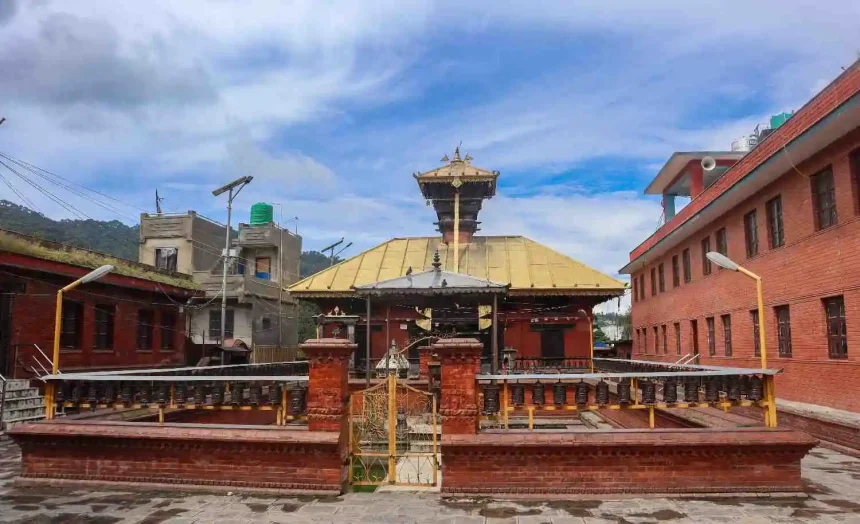
Nala Karunamaya: Shristikanta Lokeshwor
Lokeshwor, widely known as Avalokitesvara, is a profoundly revered Bodhisattva in Mahayana Buddhism who embodies the infinite compassion and mercy of all the Buddhas. His name derives from the Sanskrit words “loka,” meaning “world,” and “ishvara,” meaning “lord” or “ruler,” thus translating to “Lord of the World.” Lokeshwor’s primary role is to represent great compassion and is dedicated to aiding and liberating all emotional beings from suffering, a devotion reflected in his many diverse forms across different Buddhist traditions and cultures.
Within the Kathmandu Valley, this compassionate presence is notably enshrined in four principal forms, known as the Four Karunamaya. These are: Padmapani Lokeshwor, also called Rato Machhindranath, whose home is in Bungamati and who is ceremonially brought to Patan; Janabaha Dyo, or Seto Machhindranath, located at Janabahal; Anandadi, also known as Adinath Lokeshwor, situated in Chobar; and the Shristikanta Lokeshwor idol, which had been stolen from Bungamati, and was subsequently re-established at its new location in Nala.

According to legend, travellers from Tibet stole the statue of Karunamaya from Bungamati. On their journey back, they reached Nala late one evening. They decided to spend the night there, burying the statue on the riverbank for safekeeping. When Vasuki Naag discovered the theft, he invoked a powerful storm with heavy rainfall, lightning, and thunder. This storm caused the Punyamata and Nandimata rivers to flood. The storm forced the thieves to abandon the statue and flee. That same night, Karunamaya appeared in the dreams of three individuals: the King of Banepa, the Paneju (a high-ranking priest associated with Machhindranath) of Bungamati, and a Pode (fisherman) from Banepa.
In their dreams, they each saw the exact location where the idol of Shristikanta Lokeshwor was buried on the bank of the Punyamata river. The three men independently journeyed to the site from their dreams. Upon meeting and realizing they had shared the same vision, they knew it was more than a coincidence and began to search the riverbank. After a long search, they successfully recovered the statue. They immediately retrieved the deity from the river and established it at the location where the present temple of Nala Lokeshwor stands today. In front of the Karunamaya temple, a temple dedicated to Vasuki Naag has been established in the middle of the pond.
Special thanks to Bijendra Bajracharya, the priest of the temple, for sharing this story with me.
Nala Ugrachandi Bhagwati
The former Ugrachandi Nala Village Development Committee (VDC) in Kavrepalanchok District was named after the Ugrachandi Bhagawati temple, a significant religious site located in Nala Bazaar. The Nala Ugrachandi area was a recognized VDC until its restructuring in 2017, when it was divided into wards of Banepa Municipality. Though currently under renovation, this temple stands as a rare and notable example of a four-tiered pagoda, a distinctive style of Nepali architecture. Its construction was a multi-generational effort initiated by the Malla kings of Bhaktapur, weaving in stories from Nala Kavrepalanchowk.
The foundations were first laid in 1620 CE by King Jagajyoti Malla. His son, King Jagat Prakash Malla, continued the work, adding the first tier in 1640 CE. The second and third tiers were completed shortly after in 1646 CE, with a wealthy local man named Devanand financing the final tier and the golden pinnacle. Despite this documented Malla-era construction, the site’s spiritual significance is believed to be much older, with its origins tracing back to the Licchavi era according to popular legend.

Photo: Sambid Bilas Pant
A Legendary Sculptor
A local legend claims that a series of renowned stone sculptures of Bhagawati, found at temples such as Palanchowk Bhagwati, Shobha Bhagwati, and Nala Ugrachandi, were all carved by a single Licchavi-period sculptor. The king, captivated by the fact that each image was more exquisite than the last, sought to ensure no one else could ever benefit from the artist’s genius. After the completion of each statue, he ordered a part of the sculptor’s body amputated. The artist first lost two fingers, then his right hand, and finally, his left. His final masterpiece was the Naxal Bhagawati, which he carved using his feet.
These images often depict the goddess in her powerful form as Ugrachandi (meaning “Fierce Goddess”), who is revered for vanquishing the demon Mahishasura. She serves as a potent symbol of protection and a means for devotees to conquer fear. The Ugrachandi Nala Temple comes to life during its major festivals, with the most significant celebration being Vijaya Dashami (Dashain).
On this day, the temple’s gold-plated idol of the goddess is unveiled to the public for a rare, two-hour viewing at midnight before being returned to its sanctum. The deity is also honored on other important occasions, such as Akshaya Tritiya, Indra Jatra, and Kartik Purnima, which are marked by a special ritual where the idol is transferred to a designated sitting house four times annually. Another key event is the Mahalaxmi Jatra, a vibrant festival during which the goddess’s chariot is paraded through the village amidst celebratory play with vermilion, events that pulse with stories from Nala Kavrepalanchowk.
I am especially grateful to Jamuna Shrestha for sharing about the festivals. She also showed me rare, massive bricks inscribed with ancient text. They were uncovered during the temple’s reconstruction but now lie neglected on the ground, awaiting scholarly study.
Nala Gadhi: A forgotten fort
Nala Gadhi, a ruined fort strategically located between Banepa and Bhaktapur, is a relic of King Prithvi Narayan Shah’s historic unification campaign. Prithvi Narayan Shah, the visionary king from the small kingdom of Gorkha, embarked on a legendary campaign to unite the many fragmented kingdoms into a single nation, ultimately becoming the first monarch of a unified Nepal. His military strategy was twofold and brilliant. Internally, he tightened the screws on the Kathmandu Valley kingdoms by building and capturing a ring of strategic forts on the surrounding hills, like Nuwakot, Dhulikhel, and Nala Gadhi. These strongholds severed crucial trade routes, isolating his rivals and exerting relentless economic and military pressure.

Externally, this same network of forts proved vital in defending the emerging nation, enabling his forces to achieve legendary victories against the militarily superior British East India Company troops at key strongholds like Sindhuli Gadhi and Jitpur Fort.
While the battles of Sindhuli and Jitpur are celebrated in history, lesser-known forts like Nala Gadhi remain crucial to the full story, awaiting further study. Today, all that remains of the fort is a central, flat-topped mound that likely served as the command post, offering a view of the ancient trade corridor between Kavre and Bhaktapur. The path leading uphill is rugged and earthy, which would have been the main access for soldiers. These features, along with the remnants of walls and a solitary reservoir, are awaiting archaeological excavation and research.
Special gratitude to resident Avinaya Bajgain for sharing the trails of his hometown.
Brahma Statue of Nala
The recently constructed massive statue of Brahma at Nala is the biggest in the country. Despite his paramount role as the creator of the universe, Brahma is the least worshipped of the three (Vishnu, the preserver, and Shiva, the destroyer). Very few temples are dedicated to him. His iconic four faces are rich with meaning, representing the four Vedas (Rigveda, Yajurveda, Samaveda, and Atharvaveda) and symbolizing his absolute mastery over all knowledge and wisdom. While Brahma initiates creation, he does not actively take part in preserving or destroying the universe, which may explain why he is less actively worshipped than Vishnu and Shiva, yet this towering effigy evokes timeless stories from Nala, Kavrepalanchowk, blending mythology with the site’s ancient heritage.
According to several Hindu texts, the origin of life is traced to a golden cosmic egg, the Hiranyagarbha, which floated in the primordial void. This egg eventually cracked open, giving rise to Brahma, who created himself from within it and thus earned the name Swayambhu, or “the self-born.” Upon emerging, Brahma initiated the process of creation, bringing forth the fundamental elements of the universe: earth, water, fire, air, and ether. In this context, the phrase “Brahma created the universe in a day” is a profound metaphor for the cyclical nature of cosmic time.
A single “Day of Brahma,” known as a Kalpa, is not 24 hours but an immense timespan of 4.32 billion human years. This Kalpa represents the active phase of creation, which is followed by a night of equal length for dissolution, together forming a continuous, unending cycle of the universe’s emergence and reabsorption.

Nala Gumba: Dhagpo Sheydrub Ling Monastery
Dhagpo Sheydrub Ling Monastery, more commonly known by its local name, Nala Gumba, stands as a significant center for Tibetan Buddhist practice and learning in the Kavrepalanchowk district. For travelers and those interested in Buddhist culture, it offers a uniquely accessible window into monastic life. The monastery is situated approximately 1,300 meters (about 0.8 miles) from the Karunamaya temple.
Upon arrival, the most immediate and striking aspect of the visit is observing the monastic community. The monastery is home to young monks, who can be seen throughout the grounds dressed in traditional maroon and saffron robes. They are often silent, yet actively engaged in their daily rituals, chores, and studies. This provides an authentic glimpse into the disciplined and contemplative lifestyle of Tibetan Buddhist practitioners.
Adorned in the vibrant and intricate style of Tibetan Buddhism, the hall of the monastery is a symphony of rich reds, greens, golds, and turquoise, with its walls and pillars covered in detailed floral carvings and sacred symbols. At its heart, a massive golden statue of Lord Buddha, holding a begging bowl and framed by an ornate halo, radiates serene calmness. This central figure is fronted by an altar filled with ritual objects, butter lamps, and offerings, symbolizing deep devotion. The polished marble floor reflects the space’s grandeur, while rows of monks in saffron robes and red hats engage in collective chanting, their synchronized presence and the sacred Tibetan inscriptions overhead creating a powerful, harmonious, and deeply spiritual atmosphere.
A clearly defined rule at Nala Gumba is its photography policy. While visitors are permitted to take photographs of the beautiful exterior grounds, the architecture, and the scenic landscapes, photography is strictly prohibited inside the Prayer Hall. This rule is in place to preserve the sacred sanctity of the most important spiritual space within the monastery. It ensures that the focus within the hall remains on devotion and contemplation rather than photography.
It is crucial for potential visitors to note that the monastery is a functioning religious institution first and a tourist destination second. Consequently, it is open to the public on one specific day of the week: Saturday, from 10:00 AM to 4:00 PM. Planning your visit on any other day will likely result in finding the premises closed to outside visitors, as this is when the monastic community engages in its private routines, prayers, and studies without external interruption.