Cultural Monuments and Untold Heritage
Nepal dubbed Tibet as ‘Bhot’ since at least 695 CE. When pronounced distinctly, ‘Bhot’ splits into ‘Bho’ and ‘da’. Banepa—once called ‘Bhont,’ ‘Bhonta,’ and ‘Bhon dey’—rose to prominence as a key outpost on the lucrative Tibet trade route. Situated 25 kilometers east of Kathmandu in Nepal’s Kavrepalanchok district, Banepa represents a significant yet understudied historical settlement, rich in Banepa heritage and monuments. Kathmandu Valley features numerous ancient towns. Banepa remains relatively undiscovered by visitors, with historical connections to the Lichhavi dynasty that attract substantial tourism.
Traditional architecture lines the town’s narrow streets, with well-preserved old houses that reflect centuries of cultural heritage. Throughout Banepa, visitors can encounter historical monuments and ancient ponds that serve as silent witnesses to its storied past.
Despite its rich heritage and historical significance, Banepa has received minimal scholarly attention, with limited documentation in academic literature and educational curricula. This ancient town offers a wealth of cultural and historical resources, including its remarkable Banepa heritage and monuments. That remains largely unexplored compared to its more frequented counterparts in the region. My journey to this hidden gem began at Lokanthali, where I boarded a local bus bound for Banepa. The 1-hour and 15-minute ride along the scenic Araniko Highway offered beautiful views of the surrounding landscape. Though the journey was occasionally jarring due to ongoing construction work on the highway.
Banepa: A Key Historical Trade Route to Tibet
The historical relationship between Nepal and Tibet is documented through both nomenclature and significant trade routes. Nepal historically referred to Tibet as “Bhot,” as evidenced by Nepali edicts from 695 CE. When pronounced distinctly, “Bhot” separates into the phonetic components “Bho” and “da.” Banepa, a strategically important town, gained prominence due to its position on the Tibet trade route.
Banepa’s trade ties with Tibet historically earned it names like “Bhont,” “Bhonta,” and “Bhon dey.” Reciprocally, Tibetans referred to Nepal as “Bal-po” or “Lho-Bal.” The earliest documented interactions between Nepal (Bal) and Tibet (Bod) occurred approximately during the 6th century. The Tan-Huang documents relating to Tibetan history with further evidence of these connections, noting: “In the Monkey Year, Tsanpo (Tibetan king) stayed in Bal-po (Nepal) during summer.” These exchanges fostered significant cultural and religious development, contributing to the formation of national identity in both regions. Additionally, these connections facilitated the establishment of accessible routes between Tibet and India.
The Arniko Highway, the sole highway connecting Nepal and China (Tibet), traverses through Banepa, underscoring the town’s continued strategic importance. This long-standing relationship has resulted in the integration of Tibetan ethnic elements into Nepal’s demographic composition.
Banepa as Binayapuri
History suggests that the town of Banepa predated King Anandadev’s reign (1147-1167 CE), existing as an established settlement before his time. According to tradition, because the original settlement faced south—a direction not considered auspicious—King Anandadev commissioned eight ponds and eight Ganesh temples throughout the area. Ganesh, being the deity worshipped at the commencement of new ventures to ensure success, was particularly significant to this development. The city subsequently became known as Binayapuri, derived from “Binayak” (another name for Ganesh). The current name “Banepa” evolved later, with “Bane” signifying business and “Pa” meaning country. This reflects its commercial character. Today, many of these historical structures have deteriorated. One notable exception is Dyo Pukhu (“the god’s pond”) that remains relatively well-preserved.

Photo: Sambid Bilas Pant
Chandeshwori Temple
The Chandeshwori Temple, a significant part of Banepa heritage and monuments, is the most famous and revered in the area. It was constructed in the 17th century, but its legend dates back to ancient times. Long ago, a demon named Chanda, blessed by Shiva with invincibility against gods and humans, began wreaking havoc. Unable to defeat him, the gods sought help from Chandeshwori, who resided in the Raktachandana forest near Banepa. Though she agreed to assist, the terrified gods fled as birds when Chanda approached, leaving her to fight alone. Their fierce battle ravaged the land, leaving behind the rocky terrain still visible around Banepa today. Eventually, Chandeshwori triumphed, striking Chanda down with her trident. From his body emerged a lingam, which now rests in a small brick temple north of the main Chandeshwori shrine. To honour her victory, a pagoda was built nearby, commemorating the goddess’s power.
On the west wall of the Chandeshwori Temple, a huge mural depicts Masan Bhairav, the god of terror. In the painting, he dances with his dogs over a body—a familiar sight in places of death. He has a blue face with wide, angry eyes, sharp fangs, and many arms holding weapons and sacred objects. His crown is decorated with skulls and flames, and a green snake sits on top. This mural is repainted every year to keep it fresh and bright. Bhairav also appears on the temple’s roof beams as one of the Eight Bhairavs. The Eight Mother Goddesses, who are forms of the goddess Durga, are depicted alongside other figures.

Photo: Sambid Bilas Pant
The Divine Gift: Chandeshwori and the Golden Buffalo Head
In Hindu tradition throughout Nepal, the practice of buffalo sacrifice to honour Goddess Durga is the common practice, with the animal’s head customarily presented as an offering at temples. However, a fascinating local legend from Banepa recounts an extraordinary reversal of this tradition involving Goddess Chandeshwori, a manifestation of Goddess Durga. According to this ancient tale, a devoted farmer in Banepa dedicated himself wholeheartedly to Goddess Chandeshwori, offering sincere prayers in hopes of finding respite from his hardships. The goddess, deeply moved by his genuine devotion, bestowed upon him a remarkable gift—a golden buffalo head—as divine recognition of his pure-hearted worship.
In profound gratitude for this miraculous blessing, the farmer later presented a Rudraksha mala (or a significant Rudraksha bead) as an offering to the revered Pashupatinath Temple in Kathmandu. This meaningful gesture established an enduring spiritual connection between the Chandeshwori shrine in Banepa and the sacred Pashupatinath Temple in Kathmandu, creating a lasting bond between these two significant religious sites.
Chandeshwori Jatra
The Chandeshwori Jatra celebrates the mythological triumph of Goddess Chandeshwori over the demon Chandasur. This significant cultural event spans three days with distinct ceremonial activities. On the first day, a ceremonial procession takes place, featuring the venerated idol of Goddess Chandeshwori. The deity is transported via chariot throughout Banepa’s streets, accompanied by traditional musical performances and cultural dances. One uphill path on the way to Chandeswori holds cultural significance for the Chandeshwori Jatra festival, where a khat (ceremonial chariot or palanquin) is carried along this route.
According to local belief, it’s considered an ominous sign if the procession is stopped while travelling on this path. The path has two distinct sections side by side. On the left side is an older path made of traditional stone slabs that look weathered, textured, and have been in place for many years. On the right side is what appears to be a more recent stone-paved path with smoother, more uniform stones. Interestingly, the traditional stone path features ancient stonework that has proven to be both durable and non-slip over many years of use, while the adjacent path represents a more modern construction approach, which was definitely more slippery.

Photo: Sambid Bilas Pant
The second day is dedicated to Mata Puja, a sacred worship ceremony where devotees seek the goddess’s divine blessings for abundance and health. This day also features a ritual torch procession, beginning at Tindhara, with participants visiting both Chandeshwori Temple and Jaleshwor Mahadev to officially commence the festival.
The concluding day centers around Kalan Daan, during which followers present offerings to the goddess, including ritualistic sacrifices, as expressions of their devotion and appreciation.
The Palaces of Banepa
Beyond the Banepa gate, a place called Layaku ground (palace ground) once stood the royal Basantapur Palace, a key part of the Banepa heritage and monuments. Originally belonging to the Lichhavi dynasty (450-750 CE) and later utilized by Rana Malla, the first king of Banepa. Following the division of Kathmandu by King Yakshya Malla (1428-1482 CE), Banepa was allocated to Rana Malla’s governance. Historian Kedarnath Pradhan is the author of a comprehensive work on Banepa’s history. He documented eyewitness accounts from individuals who had observed at least one story of what was reportedly a nine-story palace complex. Based on these testimonials and archaeological evidence, the palace featured an elephant stable in its central section. A pond and garden to the south, the Damaju Devi shrine in the southwest corner, temples in the east, an arsenal building in the southeast corner, and administrative facilities to the north. In 1950, portions of the palace were demolished to create a recreational ground.
The Mayaju: Fa Palace and the ruins of Taleju temple in Banepa
The once significant palace, a crucial part of the Banepa heritage and monuments. Served as the residence for the youngest queen of King Ranajit Malla, the last ruler of Bhaktapur, who is believed to have been from the Manandhar caste. The excavation of the Taleju Aanga Chhen temple in the vicinity strongly suggests a connection to the Malla kings, as Taleju was their lineage deity.
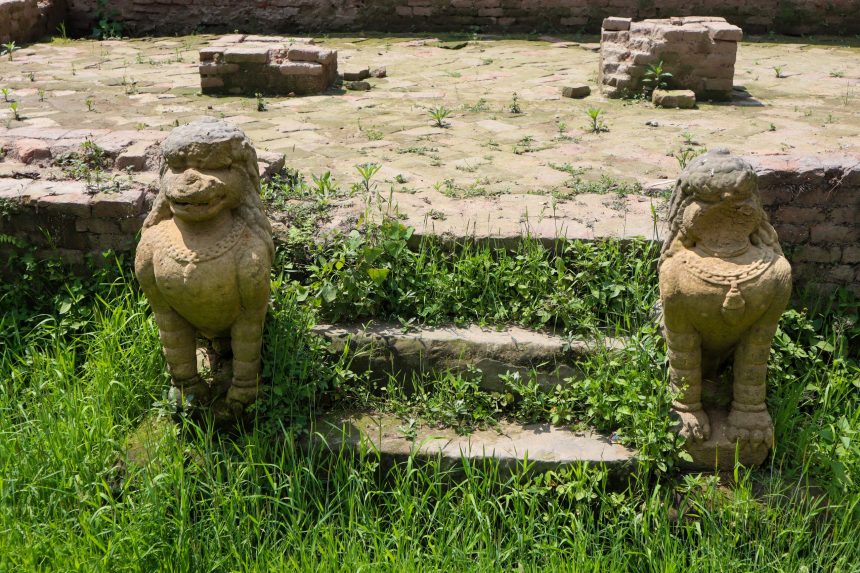
Notably, the temple’s architecture and Vastu principles bore similarities to the Taleju temple of Bhaktapur. Archaeological findings in the area, including wall structures, ancient artifacts, guardian lion statues, temple components, and bells, are vital for understanding the Banepa heritage and monuments. This further corroborates the historical presence of both the palace and the temple. It is believed that a series of earthquakes and fires led to their eventual destruction. The prominence of the Taleju goddess as the kuldevi or lineage deity of the Malla kings underscores the religious and cultural importance of this site during that era.
Adjacent to the ruins is the Teen Hiti, also known as Swotha Hiti, with three stone water spouts. It was once an important water source that served both royalty and commoners for centuries. It used to provide water to half of Banepa and even supplied water to the revered Taleju temple. Today, only one spout gives a weak trickle. It’s disheartening to see that traditions respected for generations and once-plentiful resources are now disappearing.
The Thanapati Narayana Temple
The Thanapati Narayana Temple, originally referred to as “Sthanapati”, derives its name from the Sanskrit words “Pati” (meaning “owner”) and “Than” or “Sthan” (meaning “place”), signifying its significance as a sacred site. Recognized as one of the oldest temples in Banepa, it is dedicated to Narayana, a revered form of Lord Vishnu, the preserver and protector in Hindu tradition.
The temple exemplifies the classic Newar pagoda architectural style. Historically, the Lichhavi kings held Lord Vishnu in high esteem, with many actively fostering Vaishnavism (the worship of Vishnu) and commissioning temples in his honor.
Similarly, the Malla kings of Nepal regarded Vishnu as a supreme divine authority, often legitimizing their rule by proclaiming themselves his incarnations or earthly representatives. This association with Vishnu reinforced their sovereignty, especially during periods of political transition or consolidation of power. Their devotion was further manifested through religious rituals and the construction of temples dedicated to Vishnu.
The Ashok Chaitya is another monument that holds significant cultural importance for the local Buddhist community. While named after Emperor Ashoka, who is credited with spreading Buddhism throughout Nepal and other regions during the 3rd century BCE, there is no definitive historical evidence linking the stupa directly to the emperor.
Archaeological assessments suggest that a key part of the Banepa heritage and monuments, the foundation of the chaitya, may instead date to the Licchavi period, although it has been renovated several times since. Historical records indicate that during King Bhoomi Verma’s reign, Banepa flourished as a settlement, likely resulting in the construction of numerous monuments throughout the area.
The Legacy of Chini Pa: Banepa’s Traditional Ayurvedic Sweet
Every city has its signature traditional cuisine, and for the ancient town of Banepa, that distinction belongs to “Chini Pa” (also known as “Chini Pakha”). This renowned sweet delicacy is notable not only for its distinctive taste but also for its medicinal properties. Once popular throughout Banepa and synonymous with the locale, Chini Pa is now exclusively available at Laxman Ayurvedic Aushadhalaya. Laxman Vaidya, the current proprietor, has personally crafted this sweet for decades, continuing a family tradition that spans four generations. “Madhab Das Vaidya, my grandfather, was renowned for producing it, and his father—my great-grandfather—initiated its commercial distribution,” Laxman Vaidya recounts.

This exceptional sweet is prepared using a carefully selected combination of milk, sakkar (granulated sugar), and various medicinal herbs. According to Vaidya, “It provides one with vitality.” During my visit, he graciously offered me a piece of this historical delicacy and declined payment. Saying, “It normally costs 30 rupees per piece, but you are our guest.”
Like many traditional foods and remedies, Chini Pa faces the threat of disappearing, yet Laxman Vaidya remains committed to preserving this cultural heritage. The energizing effects of the sweet proved beneficial as I continued my exploration of Banepa’s lesser-known historical sites before boarding a bus back to Kathmandu.