High in the Himalaya stands a forgotten world where a medieval walled city, a towering royal
palace, and haunting five-storey sky caves cling to the cliffs of Mustang, guarding the last secrets
of the ancient Kingdom of Lo. “Lo” is the indigenous name of the ancient kingdom itself, the land that later came to be known as Upper Mustang. “Manthang” (or Mantang) is derived from Tibetan words: “man”, meaning medicine or medicinal substance, and “thang”, meaning plain, field, or open plateau. Thus, “Manthang” literally means “the plain/field of medicine.” For centuries, Upper Mustang has fascinated travelers. Even today, its walled city and ancient caves remain shrouded in mystery. For those seeking the ultimate adventure, exploring Lo Manthang offers a journey back in time to a place where history feels frozen in the desert air.
Known as the ‘Last Forbidden Kingdom,’ this region of Nepal was closed to foreigners until 1992, opening only gradually thereafter as a restricted area requiring special permits. This isolation has allowed visitors a rare glimpse into its preserved traditions, landscapes, and ancient culture. Its monasteries and unique lifestyle endure, making it a truly mysterious land, the last untouched realm, a world yet to be fully explored.
The Great Wall of Lo Manthang: The Forbidden Kingdom

Lo Manthang was founded by Ame Pal, the first king and founder of the Kingdom of Lo in 1380 CE. After unifying the feuding fortress chiefs along the Kali Gandaki trade route, Ame Pal decided to build a permanent capital for the newly unified land of Lo. After consolidating power, Ame Pal searched for a suitable place to establish a capital city for his people. According to local oral traditions, Ame Pal prayed all night and then set out with a herd of sacred goats. Some versions say he followed the goats wherever they went. Other versions say that after falling asleep, he awoke to see the goats mysteriously emerging from the ground in the smooth plain below Dzong. Interpreting this as a divine sign, Ame Pal founded the city on that spot. From that time onward, the goat’s head became the sacred emblem of the city. Today, exploring Lo Manthang allows one to witness these deep-rooted legends firsthand, as the spirit of Ame Pal’s vision still resonates within the towering walls of this high-altitude sanctuary.
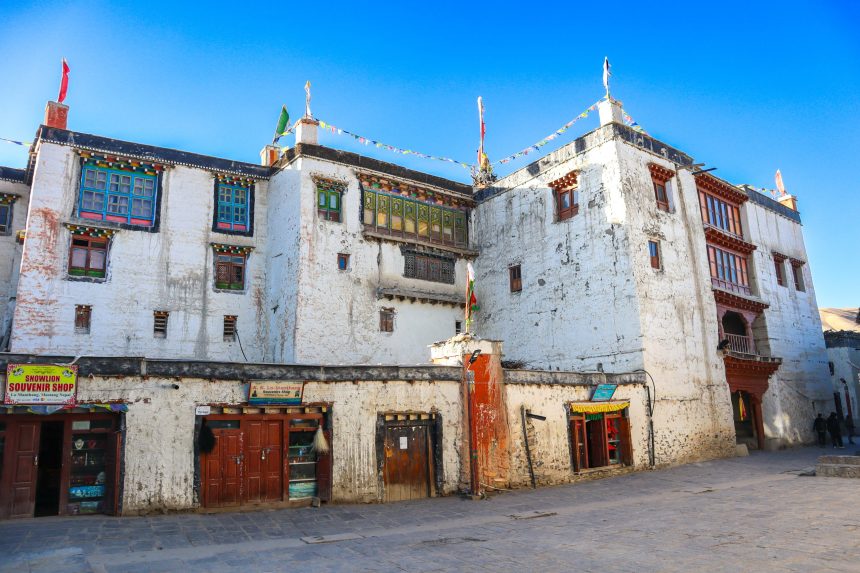
Lo Manthang was constructed as a walled fortress city in a rectangular form, with the northeast corner cut away, giving it the shape of a broad L. The city was carefully planned, enclosed within massive defensive walls and entered through a single main gate. Stretching 563 meters in length, this imposing structure physically enclosed and safeguarded the urban core of Lo Manthang. More than just a fortification, the wall symbolized the kingdom’s independence and its deliberate separation from the outside world, physically enforcing its “forbidden” nature for generations. The streets are extremely narrow, winding alleys, with houses built shoulder to shoulder. The houses are flat-roofed, mud-brick structures, usually three storeys high, packed so closely that rooftops form a continuous terrace. Monastic complexes are not separate suburbs; they are woven directly into the urban fabric, showing that religion is not outside the city but at its core. I am very grateful to Chiten Gurung of Choedhe Gumba, who shared the history of the wall with me and showed me its oldest sections, both inside and outside.
The Tashi Dyaphel Palace: The Fortunate Palace

The Tashi Dyaphel Palace (“the fortunate palace”) is the historic royal seat at the center of the walled city. The Tashi Dyaphel Palace stands inside the city wall of Lo Mantang, near the main city gate and overlooking the central square called the “De.” Founded in 1380 by King Ame Pal, who constructed the city’s walls and the original four-story palace, it was home to 25 successive monarchs of the Lo dynasty.
Lo Manthang functioned as the capital of an independent kingdom for over 600 years before its integration into Nepal in 1789. The city earned the title “Forbidden Kingdom” due to its profound isolation, a status that was officially enforced until 1992. This long period of secession successfully preserved its distinct cultural heritage, which endured until the monarchy was dissolved with the establishment of the Republic of Nepal in 2008.
Although visitors are no longer allowed inside the palace and the state of the garden is unknown at present, it is believed that the biggest attraction was the Palace Gardens, “The Happiest Place in Lo”. Inside the palace wall was the king’s private garden, containing willow trees. Watered by a system of irrigation ditches and small canals bringing water to every tree. Trees are described as an extreme luxury in Lo, so the garden was treasured deeply. Though the king, queen, and their court left the Lo Manthang royal palace after the 2015 earthquake, one loyal soul remains. A local Bhote Kukur now stands watch over the palace, its fierce barks creating the impression of a guard still dutifully protecting the forsaken throne.
Thubchen Monastery
While exploring, the Lo Manthang Thubchen Monastery is one of the three principal monasteries. It is a historically significant structure dating to the late 15th century. Founded during the reign of King Tashi Gon, the gompa is a traditional construction of stone, clay, and wood. It serves as a vibrant center for the annual Tiji Festival each May, a major cultural event where monks perform sacred masked dances and rituals to commemorate the victory of good over evil, attracting pilgrims from around the world.
Lo Manthang Museum
Chhewang Rinzin Gurung returned from Germany with the intention of doing something meaningful in his homeland, and instead of choosing an easier life abroad, he transformed his ancestral house in Lo Manthang into a cultural museum. The exhibition includes large copper vessels with brass detailing, traditional ladles, and old-style kitchen setups that show how food was prepared and communities gathered around the hearth.
You can also see traditional churners and storage containers, tools that speak of a time when everything was handmade and self-sustained. In another section, there are weaving tools, wool, and handwoven fabrics with vibrant stripes, evidence of the region’s rich textile tradition. The loom and yarn baskets reflect how craftsmanship was an integral part of daily life, especially in the harsh Himalayan climate, where warm clothing is essential for survival. The setting of the museum is still carrying the warmth and simplicity of a lived-in home. Nothing appears staged, and it feels like time has paused inside these walls, allowing visitors to step directly into the past.
I find it deeply inspiring when individuals choose to give back to their homeland despite the challenges. In a time when many feel compelled to leave Nepal in search of better opportunities, his decision shows a different kind of courage, the courage to build something meaningful at home.
The Mysterious Sky Caves of Shija Jhong

There are an estimated 10,000 man-made caves in the Upper Mustang region of Nepal, often referred to as the “Sky Caves”. Among them, the Shija Jhong Cave remains one of Mustang’s greatest archaeological enigmas. A marvel of ancient engineering, the Shija Jhong Cave is a five-story complex carved into a cliff around 800 BCE. With over 40 rooms linked by steep passages, this site has been a secluded retreat, a sacred burial ground, and a secret refuge for millennia.
The structure is not a natural cave system but an artificial, rock-cut fortress. Its design is both practical and ingenious, featuring a natural skylight that provides ventilation throughout its complex interior. From the floor, the caves look like tiny dark holes in a vast wall of stone, giving the impression of a gigantic beehive. Each “storey” is vertically stacked, one above another. The caves contain stone-built inner walls, proving that they were not just shelters but carefully planned constructions. The façade of the cliff shows a regular geometric pattern of openings, indicating deliberate architectural design.
Inside, the various chambers reveal clues about their historical uses. Many have crude tanks and bins carved directly into the stone walls, likely for storing essential supplies like water and grain. Others, with simpler layouts, appear to have been sleeping quarters. Evidence of daily life is further confirmed by several chambers whose ceilings are blackened with soot, indicating they were once used as kitchens. The cave’s history is long and multifaceted. Archaeological evidence suggests its earliest use dates back to 1000 BCE, when it served as a burial chamber. Over the centuries, its purpose expanded significantly. Experts speculate that, beyond being simple living quarters, the caves functioned as a multi-purpose sanctuary. They are believed to have been meditation chambers for monks, a secure refuge for villagers during enemy attacks, storage facilities for grain, and strategic lookout posts during battles.
This defensive role was particularly crucial for the local population. Because the valley was frequently under threat during wars, the people of Chhoser and adjacent villages would retreat to these caves to hide and escape the brutality of invading forces. Access routes had largely collapsed, making the site almost impossible to climb. However, wooden ladders have been added now, making it somewhat possible for tourists to explore most of the rooms.
Korala Pass Border

Korala pass, an ancient trade route that for centuries connected Tibet and the Kingdom of Lo (Upper Mustang). This vital corridor facilitated the exchange of Tibetan salt and wool for Nepali cereals and spices. More than just goods moved along this path; it also saw the flow of monks, scholars, and artists, leading to a rich blending of Tibetan and Nepali cultures that remains visible in local monasteries and customs.
Following political unrest in the mid-20th century, the border was officially demarcated in 1961 and heavily regulated. However, it has been reopened for international trade since the 2020s and is now considered a viable alternative to other closed crossings. Stepping onto this historic pass now is to walk in the footsteps of traders and pilgrims, a feeling enhanced by the modern pleasure of enjoying a cup of coffee and bringing back goods from Lhasa, just as in the old days. This resurgence of activity has brought a new energy to the region, making the experience of exploring Lo Manthang even more profound as the ancient trade routes breathe with life once again.