
Convicted Without a Body: The Decisive Evidence Behind the Naresh Bhatt Verdict

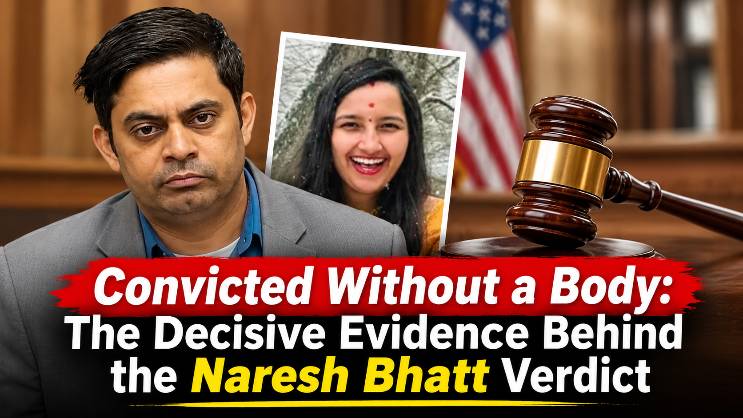
A Virginia jury found Naresh Bhatt guilty of first-degree murder, even though his wife’s body has never been found.
No body was ever found, yet a Virginia jury still convicted a man of murder. The Naresh Bhatt verdict came on November 10, 2026, when a Prince William County jury found him guilty of first-degree murder. The jury also convicted him of concealing and defiling a dead body.
Bhatt, 39, was accused of killing his wife, Mamta Kafle Bhatt, 28, a registered nurse in Manassas, Virginia. Specifically, she was last seen alive on July 30, 2024, and was not reported missing until August. Meanwhile, her remains have never been recovered.


“This verdict represents an important measure of justice for Mamta Kafle Bhatt.” — Amy Ashworth, Prince William County Commonwealth’s Attorney
The Official Verdict at a Glance
Here are the key facts from the Mamta Kafle Bhatt murder trial, so you can scan them quickly:
- Verdict Date: November 10, 2026, after a six-week trial.
- Charges: First-degree murder, concealing a dead body, and defiling a dead body.
- Jury Decision: Unanimous, reached more than four hours after deliberations began.
- Possible Sentence: 20 years to life in prison.
- Sentencing Date: March 12, 2027.
Who Were Mamta and Naresh Bhatt?
Both Mamta Kafle Bhatt, 28, and Naresh Bhatt, 39, were originally from Nepal before settling in Manassas, Virginia. Mamta worked as a registered nurse at UVA Health Prince William Medical Center, where colleagues remembered her as warm, hardworking, and devoted to her career. Naresh had previously served in the U.S. Army Reserve and worked in information technology.
According to Bhatt’s courtroom testimony, the two met on Facebook around 2020 after a prior arranged engagement of his fell through in Nepal. Within two weeks of talking online, they decided to marry. After moving to the United States and experiencing two miscarriages, Mamta gave birth to their daughter in August 2023.
Behind closed doors, however, the marriage frayed. While Bhatt claimed their early years were happy, jurors saw messages and photos Mamta sent to relatives and friends showing facial injuries, including a February 2024 message to her brother reading, “I am not safe.” Prosecutors also presented text messages showing the couple had argued over divorce in the months leading up to her disappearance.
The Crucial Evidence Jurors Weighed
Prosecutors built their case on a chain of physical, digital, and eyewitness proof. Notably, no single item carried the case alone, but together they formed a clear timeline:
- The Murder Weapon & DNA: Prosecutors identified a Ryobi electric power saw—purchased at Home Depot in June 2024—as the murder weapon, presenting lab results showing Mamta’s DNA inside the tool.
- Hidden Blood Patterns: Forensic investigators used Bluestar luminol testing to uncover extensive bloodstains matching Mamta’s DNA beneath the master bedroom carpet and inside the bathroom.
- Digital Search Records: Months before her disappearance, Google searches on Bhatt’s devices asked “what happens if a spouse goes missing” and “can you get a divorce after a wife goes missing.”
- Surveillance & Disposal Footage: Walmart CCTV from July 31, 2024, showed Bhatt buying cleaning supplies and disinfectant, while separate video captured him wearing gloves and dumping heavy trash bags into commercial compactors.
- Family Testimony: Mamta’s brother testified about his long-running fears for her safety inside the marriage.
The Kathmandu Post’s trial explainer and CNN’s trial report add more detail on how each witness fit into the timeline.
What the Defense Argued
Bhatt took the stand and made a startling admission. He testified that he dismembered his wife’s body after finding her dead on their bedroom floor on July 30. However, he denied killing her.
His account was that she died by suicide and that he panicked, cutting up her body so it would fit into trash cans. The jury rejected that claim. In short, admitting to the lesser charges of handling the body did not persuade them he was innocent of murder.
The Surprising Legal Rule Behind No-Body Convictions
Many readers ask how this is possible. In U.S. courts, prosecutors do not need an eyewitness, a video of the act, or a body. Instead, they can rely on circumstantial evidence in murder cases.
Direct evidence proves a fact on its own, such as a witness who saw the act. Circumstantial evidence, by contrast, points to a fact through a chain of connected clues. Consequently, many independent clues that all point the same way can be just as strong.
Either way, the standard stays the same: guilt must be proven beyond a reasonable doubt. Jurors decide whether the combined evidence meets that bar. Here, all twelve agreed that it did.
What Happens Next in the Case
Sentencing is the next step. A judge will set the final penalty on March 12, 2027, where Bhatt faces 20 years to life in prison. Meanwhile, the couple’s young daughter—who was 11 months old when Mamta vanished—is safe and being raised by Mamta’s relatives, though her family still has no remains to bury.
For official statements, read the Commonwealth’s Attorney’s verdict statement. For wider community reaction, follow our Nepali diaspora news coverage. We will update this article after the March 2027 hearing.
Frequently Asked Questions
-
Has Mamta Kafle Bhatt’s body been found?
No. Her remains have never been recovered. Prosecutors argued that Bhatt disposed of her body in commercial dumpsters whose contents were later transported to a landfill in Luray, Virginia.
-
Why did Naresh Bhatt admit to dismembering her body?
His defense tried to explain away the blood evidence, power saw, and cleaning supply purchases by claiming she died by suicide and he panicked—hoping jurors would convict him only of concealing and defiling a corpse rather than first-degree murder.
-
What happened to Mamta Kafle and Naresh Bhatt’s daughter?
Their daughter, who was an infant at the time of Mamta’s disappearance in July 2024, is in the custody and care of Mamta’s family members.
-
When is Naresh Bhatt’s sentencing?
Sentencing is scheduled for March 12, 2027, in Prince William County Circuit Court.