Internet Services Suspended in Arunachal’s Upper Siang as Anti-Dam Protests Intensify

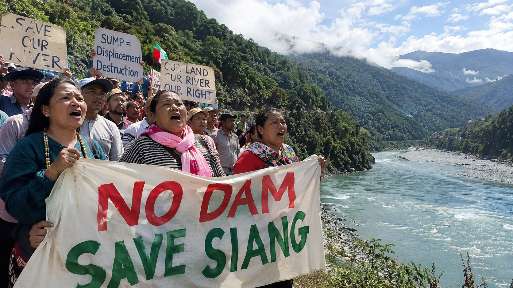
Authorities impose restrictions ahead of a 36-hour bandh as indigenous communities oppose the proposed 11,200 MW Siang Upper Multipurpose Project, raising concerns over land, displacement, environmental damage and local consent.
Mobile internet services were suspended in Arunachal Pradesh’s Upper Siang district ahead of a 36-hour bandh called by organisations opposing the proposed Siang Upper Multipurpose Project (SUMP), intensifying an already tense standoff between local communities and the state government.
The internet suspension came into effect on the night of November 1, ahead of the bandh scheduled to begin at 5 am on November 2. The protest was organised against the proposed mega hydropower project, which has become a major source of disagreement between the government and indigenous communities in the Siang Valley.


Authorities said the restrictions were necessary to maintain public order amid concerns about potential unrest. The administration also declared the bandh illegal and deployed security personnel in affected areas.
According to officials, the shutdown was particularly effective in Yingkiong and Geku. Deputy Commissioner Ashok Tajo said the impact was more limited in neighbouring East Siang district. Siang Superintendent of Police Kamdam Sikhom said schools, shops and government offices continued to operate normally in Siang district.
Reports from Monday afternoon indicated that the bandh was largely peaceful, although road blockades and the closure of shops were reported in some locations. The protest was expected to conclude on November 3.
Why are communities opposing the Siang mega dam?
The proposed Siang Upper Multipurpose Project is a major infrastructure initiative planned on the Siang River in Arunachal Pradesh. Its proposed capacity has been discussed in the range of approximately 11,000 MW to 12,500 MW, with 11,200 MW frequently cited in recent coverage.
The project is being presented by the government as strategically important, particularly because of China’s upstream infrastructure development on the Yarlung Tsangpo River in Tibet. The river enters India as the Siang before becoming part of the Brahmaputra river system.
The government has highlighted the project’s potential role in hydropower generation, flood management and national security.
However, indigenous communities in the Siang Valley have raised concerns about the possible consequences for their ancestral land, traditional livelihoods, settlements, river ecosystems and cultural heritage.
For many residents, the opposition is not simply about electricity generation. It is also about who gets to make decisions concerning the river and the future of communities living along its banks.
Protest organisations demand withdrawal of security forces
The bandh was organised by the Siang Indigenous Farmers Forum (SIFF) and the Siang Upper Multipurpose Project Affected Area Youth Association (SAAYA), with support from student unions and other community organisations.
The protesters have raised several demands, including:
- Unconditional release of people detained during earlier anti-dam protests.
- Suspension of the pre-feasibility report (PFR) survey activities.
- Withdrawal of Central Armed Police Forces (CAPF) deployed in project-affected areas.
- Greater consultation with indigenous communities before proceeding with the project.
The organisations argue that the deployment of security personnel to facilitate survey activities has increased tensions rather than building public confidence.
The dispute has also extended beyond the bandh itself, with community representatives questioning the government’s approach to obtaining local consent for the proposed project.
Disagreement over public consent
The government has maintained that approximately 2,000 households in the Siang Valley have expressed support for the proposed pre-feasibility studies.
However, SIFF has challenged this figure, arguing that most communities across the 32 villages and towns expected to be affected in Siang and Upper Siang districts remain opposed to the project.
The government has reportedly pursued memorandums of understanding with willing families and villages to facilitate the PFR process. Images of residents participating in these agreements have also been shared through official social media channels.
Opposition groups, however, say that such agreements do not necessarily represent the views of the wider population.
The disagreement highlights a central question in the ongoing dispute: whether the process adequately reflects the concerns and consent of all communities that could be affected.
Arrests and restrictions have deepened tensions
The latest confrontation follows several months of protests, preventive measures and security deployments.
On October 9, four people were reportedly detained under the Arunachal Pradesh Unlawful Activities (Prevention) Act, 2014, with authorities citing concerns about violence, arson and public safety.
Restrictions on public gatherings were subsequently imposed in Upper Siang. A 12-hour bandh on October 23 also turned violent in parts of the region, particularly around Pasighat.
Police officials have reportedly referred to more than 50 criminal cases registered across three districts in connection with the unrest, although reported figures have varied.
Protests have also taken place in Itanagar, where demonstrators raised concerns about arrests and the increasing deployment of security forces in project-affected areas.
Authorities have defended their actions as necessary for maintaining law and order. Protest organisations, meanwhile, say the measures have created an atmosphere of pressure and mistrust.
Decades of opposition to mega dams in the Siang Valley
The latest demonstrations are part of a much longer movement against large hydropower projects in Arunachal Pradesh.
Opposition to damming the Siang River dates back to around 1980, when early proposals by the Brahmaputra Board to develop the river for flood control prompted the formation of the Siang Bachao Andolan.
The movement emerged as local communities began raising concerns about the consequences of large-scale intervention in the river system. The state government subsequently opposed the central proposal following public resistance.
The debate intensified after the Union Government introduced its hydropower development policy in 2003, seeking to harness substantial electricity-generation potential across the country, including in Arunachal Pradesh.
Between 2007 and 2015, more than 200 hydropower-related memorandums of understanding were reportedly signed with private and public companies in the state, according to the historical account provided by anti-dam campaigners.
In December 2017, NITI Aayog proposed the Siang Upper Multipurpose Project, with a proposed capacity ranging between 11,000 MW and 12,500 MW.
Since then, opposition has continued among communities concerned about displacement, environmental consequences and the future of the Siang River.
Protesters have also questioned the changing political positions of national and state leaders. They point to earlier public statements opposing or expressing reservations about mega dams and compare them with subsequent government efforts to advance hydropower development.
The government, on the other hand, has increasingly highlighted the strategic importance of the Siang River in the context of China’s upstream activities.
Dispute over the proposed survey locations
According to the government’s plans, pre-feasibility report activities are proposed at three locations: Parong and Dite Dime in Siang district, and Uggeng in Upper Siang district.
Uggeng, also locally known as Konggong Lingkok, is situated on the left bank of the Siang River near Komkar village. It has emerged as one of the important centres of recent opposition.
Communities on both banks of the river have participated in protests, reflecting concerns that the project could have consequences extending across multiple villages.
SIFF has also called for the withdrawal of Central Armed Police Forces deployed in Siang, Upper Siang and East Siang districts.
The organisation has questioned the use of security personnel during survey activities, arguing that meaningful dialogue should take place before the government proceeds with the project.
National security versus indigenous rights
The government has repeatedly presented the project in the context of national security, flood management and China’s growing infrastructure activities upstream.
The concern is linked to China’s development plans on the Yarlung Tsangpo, which flows into India as the Siang and eventually forms part of the Brahmaputra.
However, opposition groups argue that strategic considerations should not override the rights and concerns of communities living in the region.
They have questioned how a project intended to strengthen national security can be justified if it potentially threatens the land, livelihoods and future of the people who inhabit the border region.
The dispute therefore extends beyond the technical and economic feasibility of a hydropower project. It raises wider questions about environmental protection, indigenous rights, public participation and the responsibilities of governments towards communities affected by major infrastructure development.
What happens next?
The immediate challenge for the Arunachal Pradesh administration is to reduce tensions and establish meaningful communication with communities opposing the project.
The government’s proposed surveys and negotiations with willing households remain contentious, while protest organisations continue to demand the withdrawal of security forces and a halt to the PFR process.
With opposition continuing across Siang and Upper Siang districts, the future of the Siang Upper Multipurpose Project will depend not only on its engineering and strategic objectives but also on how the government addresses local concerns.
The central question remains whether a project of such scale can move forward without the confidence and meaningful participation of the indigenous communities whose lives and land could be directly affected.
*This report draws on published reporting and statements attributed to government officials and protest organisations. Claims concerning public consent, arrests, security measures and the project’s potential impact reflect the positions of the respective parties and should be considered in that context.