Though annexed by Nepal in the eighteenth century, Mustang maintained its king and a degree of autonomy through a positive relationship with the ruling Shah kings. The royal family of Mustang and nobles were strong Buddhists who paid for the construction of beautiful temples and monasteries in Mustang, many of which are still there. Yet beneath this vibrant Buddhist culture lie traces of much older religions and traditions. Mustang unfolds from the history of Kagbeni Mustang and its ancient palace, past the turquoise gaze of Dhumba Lake, through the apple-scented streets of Marpha, and up to the sacred flames and waters of Muktinath.
The Sacred Village of Kagbeni
Kagbeni is a sacred village in Varagung Muktikshetra municipality, 12 km from Muktinath. The history of the name Kagbeni has several interpretations. According to the Nepali meaning, the word is derived from ‘Kag’ and ‘Beni’. In this context, ‘Ka’ refers to the Kali River, ‘Ga’ refers to the Gandaki River, and ‘Beni’ means the confluence of rivers. Thus, Kagbeni is the place where these two rivers meet. Another interpretation suggests that ‘Kag’ comes from words like ‘Ghag’ or “ghak,” meaning ‘center,’ which is fitting as the village lies in the central region. Alternatively, a legend from the Ramayan states that the divine crow Kagbhusundi meditated here on the suggestion of the Saptarishis, and the village was named after him. Kagbeni is a key stop on the pilgrimage to Muktinath, where Hindu devotees perform Shraddha rituals and offer Pinda to help their ancestors achieve Mokshya (liberation from the cycle of life and death).
The village is home to several monasteries, making it an important site for Buddhist practice and visitation. The oldest monastery in Kagbeni is the Kag Chode Thupten Samphel Ling monastery was established in 1429 CE by the monk Tenpai Gyaltsen. It is called the Red Monastery because of its ancient architecture, which features rammed-earth walls and timbers designed to resist earthquakes and attacks.
Kag Khar: the Palace of Kagbeni
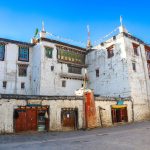
Kagbeni Palace, historically known as Kag Khar, is a significant historical and architectural landmark in Mustang. While local oral histories date the original structure to approximately 1,200 years ago, the visible remains today consist of a four-story rampart. The palace was constructed using traditional adobe clay, a building material common to the region. The palace served as the seat of a local king who governed a substantial territory in Upper Mustang. Historical narratives, primarily passed down through oral tradition, indicate that this ruler originated from Jumla. From this strategic fortification, the Jumla ruler is said to have challenged the authority of the King of Lo in Lomanthang. His domain is believed to have extended from Pandakhola to Ghiling.

However, the precise historical identity of this Jumla ruler remains unconfirmed by external records. The palace’s legacy is preserved in the local culture, particularly during the Yartung festival. A traditional song performed by Kagbeni villagers honours Kagbeni Palace and narrates the mythic origins of its construction. According to this legend, the palace was built on a site created by the draining of a lake.
The Khenis: The Ghost Eaters of Kagbeni
Kagbeni was originally founded within a defensive perimeter wall. This wall featured two main entry-exit points, which were once guarded by human guards. These human guards were symbolically replaced by two carved figures known as Khenis, or “the ghost eaters.” The two figures, one representing a man and the other a woman, were installed at the village gates as perpetual spiritual guardians. They are considered powerful protectors believed to safeguard the Kagbeni area from negative influences and supernatural forces. Their primitive appearance is a direct reflection of the age-old animist beliefs, which attribute spiritual essence to natural objects. It was practised in this area long before the arrival of Tibetan Buddhism in the 11th or 12th century.
Muktinath: A Sacred Pilgrimage Destination
Muktinath stands as one of the most significant pilgrimage sites in the Himalayas. It is located at an altitude of approximately 3,710 meters at the foot of the Thorong La mountain pass, close to the village of Ranipauwa in the Mustang region. This sacred complex represents a unique convergence of Hindu, Buddhist, and indigenous religious traditions, making it a truly universal spiritual destination that transcends religious boundaries.
For Hindu pilgrims, Muktinath holds immense significance as the 105th pilgrimage destination among the 108 Divya Desams (divine abodes of Vishnu) and the only one located in Nepal. The temple houses a statue of the deity of Muktinath, standing approximately one meter in height, along with his two consorts, the goddesses Lakshmi and Saraswati. The central shrine, known as the Vishnu temple, also contains three principal Shaligrams that permanently reside at the deity’s feet, representing the three principal deities. One of the most distinctive features of Muktinath is the presence of 108 bull-faced waterspouts that line the outer courtyard sanctum. These sacred waterspouts are believed to represent the sacred waters from all other Divya Desams, including those considered outside the earthly realm. Pilgrims to Muktinath must bathe in the two front water pools to cleanse away all karmic sins and receive life-long blessings.

Beyond its Hindu significance, Muktinath is equally revered by Buddhists. In Buddhist tradition, the central deity is Avalokiteshvara, the lord of compassion, who resides in the main shrine. According to Tibetan texts, Muktinath is also said to be the place where Guru Rinpoche (Padmasambhava), the founder of Tibetan Buddhism, meditated on his way to Tibet. The temple complex is administered by an order of Buddhist nuns alongside Hindu priests who are responsible for temple care and ritual practices, ensuring that both Hindu and Buddhist traditions are honored and maintained. The Buddhists refer to the 108 water spouts in the complex as Chumig-Gyatsa, meaning “Hundred Waters” in Tibetan. For Buddhist practitioners, Muktinath is also believed to be one of the main sacred locations for the 21 Taras (female deities) and the Dakini (Sky Dancer Goddesses), as well as one of the 24 Tantric places of meditation.
Dhola Mebar Gompa (Jwala Mai Temple)
The entire Muktinath complex encompasses numerous shrines and spiritual structures, among them the most significant being the Dhola Mebar Gompa (also called the Jwala Mai Temple), The temple is located within the Dhola Mebar Gompa and is a sacred site revered for its eternal natural flame. For thousands of years, pilgrims have visited to witness this unique phenomenon where the five elements converge: earth, air, water, fire, and the underlying natural gas.
The small, blue flames burn continuously on a water spring, hidden behind a grille on the temple floor. To view them, visitors kneel and peer through the opening. This combination of a sacred flame and a flowing spring makes the temple a place of profound spiritual significance for both Hindus and Buddhists. For Buddhists, the site is known as Sale Mebar (burning earth), Do Mebar (burning stone), and Kla Mebar (burning water). Additionally, the complex features a series of chorten (monument stupas) dedicated to the deceased and one of the tallest statues of the Buddha in Nepal.
While the exact antiquity of the Muktinath temple complex remains debated among scholars, textual references in Hindu Puranic texts suggest that the sacred landscape of the Kali Gandaki River may have been revered as far back as the Vedic period. The site is mentioned in significant portions of the Ramayaṇa and other ancient texts as “Mukti Tirtha” (the great bridge), suggesting that Hindu pilgrimage to Muktinath predated the arrival of several modern ethnic groups to the area.
The current statue of Muktinath likely dates to the late sixteenth or early seventeenth century, possibly established during the rule of Jumla. Tibetan sources from around AD 1080 to 1110 document knowledge of a place called “Mukti-jwala,” also referred to as Chhu-la-me-war (fire on water), Do-la-me-war (fire on rock), and Sa-la-me-war (fire on earth), indicating the site’s long-standing significance across multiple cultures and traditions. What makes Muktinath truly extraordinary is its ability to serve as a meeting point for diverse spiritual traditions and pilgrims from across South Asia and beyond. The site embodies the principle that any single religious tradition does not define Muktinath but rather represents a blending of Hindu, Buddhist, and Bon practices. Pilgrims arrive from various backgrounds, some seeking salvation through Vishnu, others seeking compassion through Avalokiteshvara, and still others honoring the sacred landscape itself.
The Shaligrams, which are central to the pilgrimage experience at Muktinath, serve as manifestations of the divine that unite these diverse traditions. Newly acquired Shaligrams undergo their first puja rituals and bathing rites at Muktinath, welcoming them to their new families and marking the transition of pilgrims from their physical journey to their spiritual journey as Shaligram devotees.

Hansa Raja Legend and The Thakali Community
The historical formation of the Thakali community, which is an integral part of Mustang’s history, is deeply tied to the region’s culture and politics, most enduringly through the legend of Hansa Raja. According to Thakali lineage histories, Hansa Raja, a prince said to have originated from Sinjapati near Jumla, married Nhima Rani, the daughter of the Raja of Thini, located in the Gharapjhong Rural Municipality. This marriage links western Himalayan royal ancestry with the local polity of the Thini and Panchgaon region in Mustang. Through this alliance, Hansa Raja is believed to have been granted the lands of Thaksatsae, an origin narrative that anchors Thakali settlement and identity within the broader Mustang region. This connection is also reinforced geographically. Thak Khola, the core Thakali homeland, is administratively part of Mustang District and forms a vital cultural subregion within it.
Stretching from Ghasa to Jomsom in the upper Kali Gandaki valley, Thak Khola includes the major Thakali settlements of Marpha, Jomsom, Tukche, Syang, and Thini, villages long positioned along one of the Himalaya’s most important north-south trade corridors. These linked mythic, geographic, and historical trajectories demonstrate that Thakali history is inextricably tied to the political landscape and cultural evolution of Mustang, where oral traditions and strategic valley geography have shaped the region’s identity.
The Marpha Village
The village of Marpha, whose name translates to “hard-working people,” is a historic settlement located in Gharapjhong Rural Municipality. It originally served as a crucial caravan stop on the Tibet-Nepal salt trade route. Its unique architecture, featuring flat-roofed houses and a network of narrow, winding alleys, was strategically designed for defense against the harsh mountain winds and remains a defining feature. A significant local landmark is the painted chorten situated on a rocky slope above the Tashi Lha Khang monastery. According to legend, a monk advised that performing specific rituals at the chorten would end the outbreak, and this sacred intervention is credited with halting a leprosy epidemic that once afflicted the village. Today, Marpha is celebrated for its thriving apple orchards and the production of artisanal goods, including its famous apple brandy.
Dhumba Lake
Situated in Gharpajhong Rural Municipality, Dhumba Lake has a length of 160 meters, a width of 130 meters, and a depth of 10 meters, all at a high-altitude location of nearly 3,000 meters. The lake’s origin is traced to the story of a humble shepherd boy who discovered a stone inscribed with a holy mantra. The moment he read the ancient script, a miraculous spring surged forth, transforming the spot into the serene lake we see today.

The site’s mystical nature was further unveiled when its waters mysteriously turned a deep, unsettling blood-red. According to legend, this ominous transformation persisted until Tibetan Buddhist monks conducted lengthy and devoted religious ceremonies, after which the waters returned to their natural state. The lake’s sanctity is forever sealed by the visit of Guru Rinpoche, the founder of Tibetan Buddhism, who meditated upon its shores.