The bridges you drive across and the tunnels beneath your feet are changing faster than most people realise. Civil engineering is no longer just about roads and buildings. Today, it’s about finding better ways to solve bigger problems and complete projects sustainably.
You can already see this happening across Asia. In September 2025, the Huajiang Grand Canyon Bridge opened in China’s Guizhou Province. At 625 metres above the Beipan River, it is the world’s tallest bridge. It turned a two-hour trip through the mountains into a two-minute drive. Building a bridge like this meant engineers had to come up with new ideas and methods that weren’t available when the project first started.
Singapore is taking a similar approach underground. Its Deep Tunnel Sewerage System is a 206-kilometre network of tunnels that moves used water via gravity, so there is no need for pumping stations above ground that can pollute. The second phase of the project includes fibre-optic cables to monitor the tunnels remotely and specially designed concrete that can better withstand damage over time.
Both projects point to the same thing: civil engineering being pushed to its limits by leaders who refuse conventional solutions. If you want to work at that level, then consider starting your journey at these top universities:
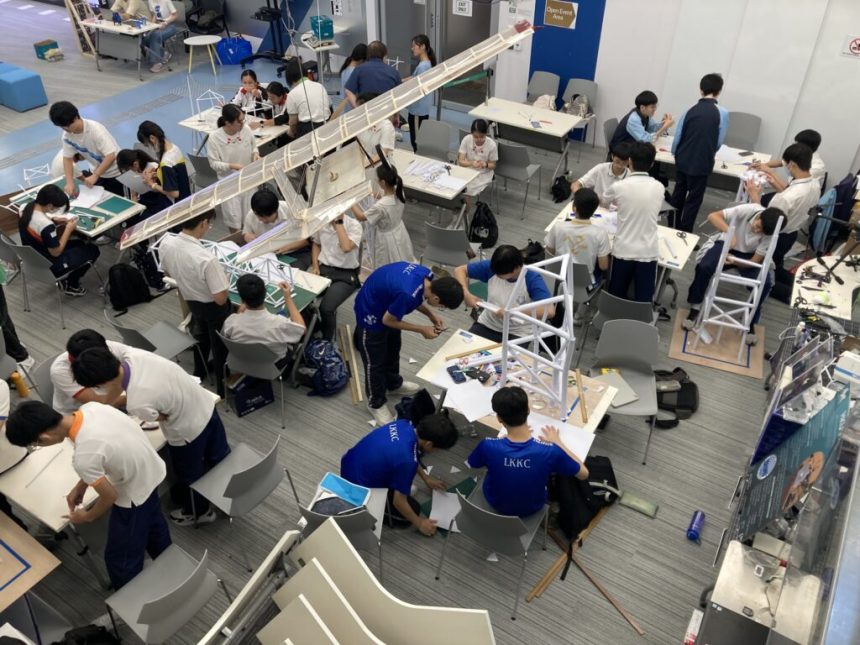
The University of Hong Kong’s Department of Civil Engineering advances education and knowledge exchange while nurturing the next generation of engineers and researchers. The students pictured above, taking part in a paper tower competition, represent the type of talented and innovative young minds the department attracts. Source: The University of Hong Kong
The University of Hong Kong
Not long ago, placing a ready-made apartment unit into place would have required seven to 10 workers and around 45 minutes of physically demanding and potentially hazardous work. Now, one robot can do the same in 15 minutes. Researchers from The University of Hong Kong‘s (HKU) Department of Civil Engineering have made this possible with the HyPA (Hybrid Pose Adjustment) robot. It uses smart cameras and cable-driven technology to automatically guide building modules into place. The project won a Gold Medal at the Geneva International Exhibition of Inventions 2024.
This is the kind of work happening at HKU Civil Engineering. Founded in 1912, the department has produced generations of engineering professionals and contributed to major projects in Hong Kong and around the world. Today, it’s ranked 20th in the world for Civil and Structural Engineering in the QS World University Subject Rankings 2025.
The four-year BEng in Civil Engineering, fully accredited by the Hong Kong Institution of Engineers, pairs this prestige with an innovative, interdisciplinary curriculum. You’ll learn about structural, geotechnical, environmental, transportation, and construction engineering. And if you want to keep your options open beyond the construction site, you can pair your degree with a minor in Business, Economics, or Finance.
A recently introduced course gives you a chance to explore how AI is changing the industry. The course is closely linked to the department’s research in Modular Integrated Construction with Digital Technology and Sustainable and Smart Infrastructure. This means you’ll learn about technologies such as AI-powered site monitoring and drone-based inspections from the people developing them.
Hong Kong makes all this even more real. It’s a city of skyscrapers, tunnels, and bridges built across hilly, coastal terrain — the kind of place that throws real engineering challenges at you every day. For four years, that’s your classroom.
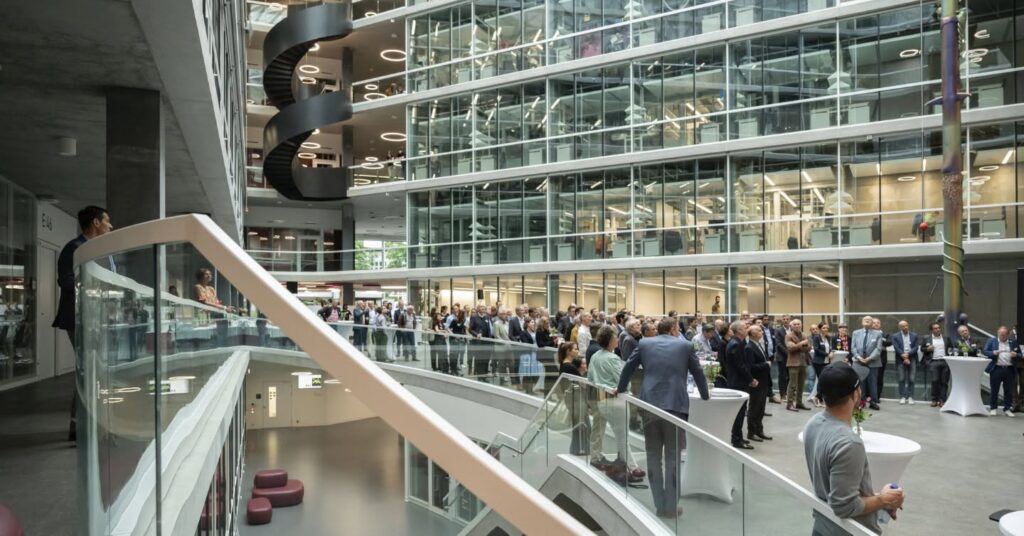
The civil engineering programme at ETH Zurich follows the internationally recognised Bachelor’s degree system. Source: ETH Zurich
ETH Zurich
What does it take to build infrastructure that can withstand earthquakes or survive catastrophic floods? At ETH Zurich‘s Department of Civil, Environmental and Geomatic Engineering (D-BAUG), researchers tackle these challenges using one of Europe’s most advanced research tools: a nine-metre geotechnical centrifuge. By spinning structural models at up to 250 times Earth’s gravity, it can recreate decades of stress on bridges and foundations in just a few hours.
This kind of research is what D-BAUG is known for. The department is ranked 4th in the world for Civil and Structural Engineering in the QS World University Rankings 2026, up from ninth place just five years ago. Its researchers are working on some of today’s biggest challenges, from ageing infrastructure and climate change to the rapid expansion of cities.
Your undergraduate journey starts with the Bachelor in Civil Engineering. During the first year, you’ll build a strong foundation in mathematics, mechanics, geology, chemistry, and computer science. From the second year onwards, the curriculum expands into areas such as hydraulics, structural engineering, geotechnical engineering, transport systems, and water resources management. You’ll also gain practical experience through a design project in the fifth semester that offers an opportunity to develop an engineering solution from the ground up.
Throughout the programme, you’ll learn directly from D-BAUG’s own researchers, who are actively applying digital innovation and AI to design smart infrastructure. As such, you’ll work with the same tools and ideas shaping the field right now.
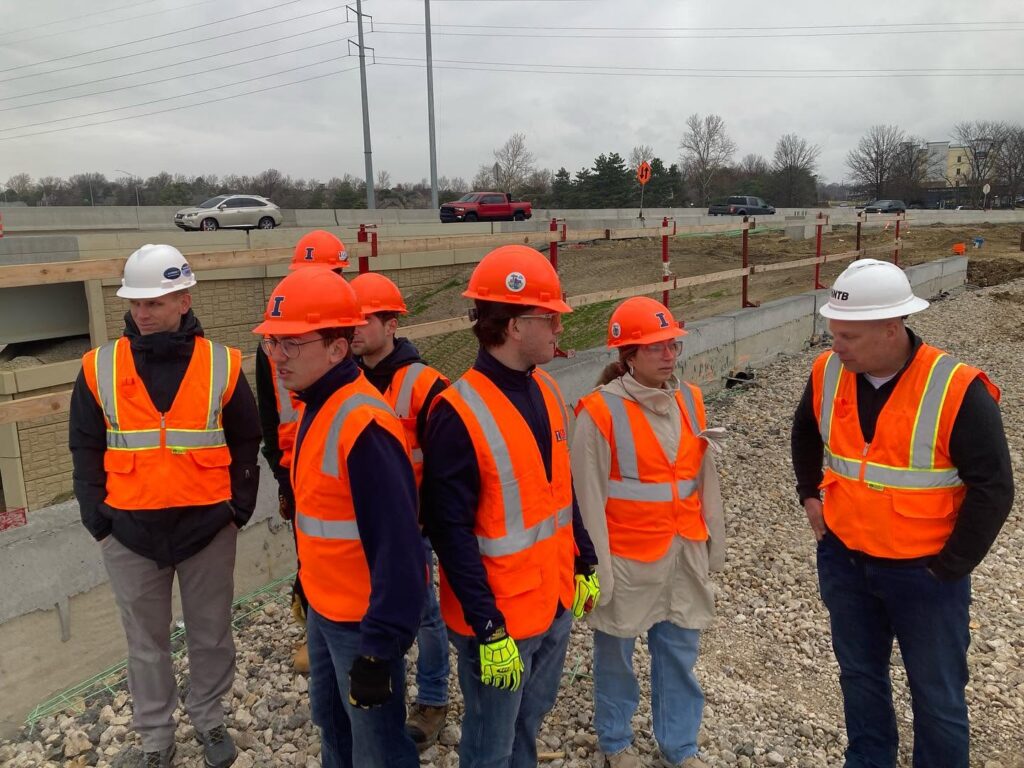
The University of Illinois Urbana-Champaign Department of Civil & Environmental Engineering undergraduate programme is consistently ranked among the top in the US. Source: University of Illinois Urbana-Champaign
University of Illinois Urbana-Champaign
A first-year class project in your undergraduate degree on cracked sidewalks canturn into a Forbes 30 Under 30 startup. That’s exactly what happened to two students after taking a course at the University of Illinois Urbana-Champaign’s Department of Civil & Environmental Engineering (UIUC CEE). Their company, DeepWalk Research, uses AI to detect pavement damage — and it started in a classroom.
UIUC CEE holds the #1 civil engineering graduate programme ranking from the 2026 US News & World Report, a position it has held for over a decade. That culture of excellence carries straight through to the undergraduate level, where research opportunities start from day one.
Here, the department offers a Bachelor of Science in Civil Engineering across seven focus areas — structural, geotechnical, environmental, transportation, construction engineering and management, construction materials, and water resources. Three interdisciplinary tracks — sustainable infrastructure, energy-water-environment, and societal risk — extend your learning further. If you’re interested in emerging technology, you can take the Certificate in Data Science and Computing too — a CEE-specific track covering machine learning and infrastructure sensing, which you can complete within your four-year degree.
Research starts early here. Courses like Project-based Introduction to CEE and Environmental Engineering Lab all include design projects, field experiences, and real-world problem-solving. Through the PURE Research Programme, freshmen and sophomores are matched directly with faculty mentors, putting them inside active research from their first year.
Of the 178 CEE undergraduates surveyed in 2024 and 2025, 100% secured employment or continued into graduate school, with an average starting salary of US$82,408.
*Some of the institutions featured in this article are commercial partners of Study International