Building a successful engineering career today looks different from what it did a decade ago, and Lamar University’s (LU) has seen this shift firsthand. “As technology evolves, a single person is unable to acquire the expertise in all engineering disciplines or even within any single engineering discipline,” says Dr. Gleb Tcheslavski, Associate Professor in Electrical and Computer Engineering. “Therefore, to be competitive, engineers with progressively more narrow-focused backgrounds are needed.”
Graduate Sheikh Muhammad Fareed, currently a Strategic Sourcing Specialist II at Honeywell, agrees. He’s seen how employers are increasingly looking for people who can combine strong engineering fundamentals with digital fluency. That could mean knowing your way around data analytics, Python, supply chain modelling, automation, AI, and digital sourcing tools. “What matters most is knowing how to use them to tell a story, identify the right problem, and support a better decision,” Fareed adds.
Below, Dr. Tcheslavski and Fareed share how graduate engineering education at LU can prepare you for technical and leadership roles.
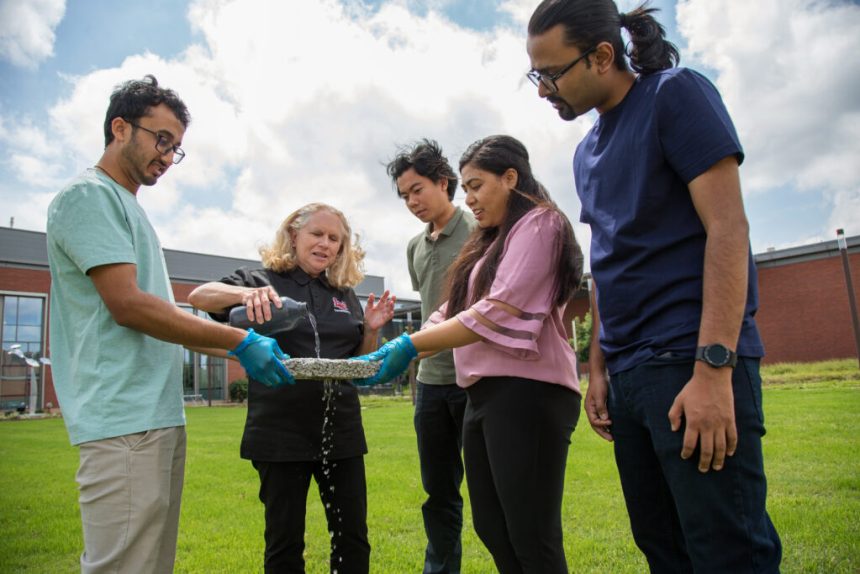
Outside of class, you can join student organisations, attend career fairs, and get involved in campus activities. Source: Lamar University
Build your expertise
The College of Engineering (COE) spans five departments, each offering industry-aligned master’s and doctoral programmes. “Courses such as applied programming, AI for industrial engineering, lean manufacturing, production and inventory control, freight transport logistics, statistical decision-making, and enterprise business intelligence helped me connect classroom concepts to business decisions,” Fareed explains. “My thesis was especially meaningful because it focused on a problem I care about deeply: how companies can use AI and simulation to manage safety stock more intelligently in complex assembly systems.”
Learn from experts
Who Fareed learned from mattered just as much. Professors such as Dr. James Curry, Dr. Alberto Marquez, and Dr. Wil-Johneen White challenged him to look at problems from a systems perspective rather than jumping straight to a quick answer. “Their guidance helped me become more confident in using analytical tools, but it also taught me patience, curiosity, and discipline in the way I approach complex problems,” he says.
These kinds of faculty relationships aren’t hard to find at LU. “The COE is a relatively small college and class sizes are often relatively small too. Interested graduate students have ample opportunities to work with faculty members,” says Dr. Tcheslavski.
Take your ideas into the real world
Finding your specialisation is important, but so is learning to put your expertise into practice. “Research projects are designed to test scientific hypotheses by producing evidence of their validity. Therefore, any suitable research activity bridges the gap between theory and practice by its nature,” Dr. Tcheslavski explains.
Fareed, for example, learned how AI and simulation can help decision-makers better understand uncertainty, test different scenarios, and make more confident choices. “It also reinforced my belief that the best research is the kind that can eventually help someone make a better decision in the real world,” he says.

COE graduates have taken their skills to Amazon, Nike, Lockheed Martin, and more. Source: Lamar University
Engineering career opportunities within reach
LU’s strategic location near Houston and the Gulf Coast’s major energy, manufacturing, and industrial sectors gave Fareed another way to connect what he was learning with the real world.
“That proximity helped me better understand the scale and complexity of manufacturing, energy, aerospace, and supply chain operations,” he shares. “It also played an important role in my career development, especially through my internship with Honeywell in Houston, where I was able to take what I was learning at LU and apply it to real sourcing and supply chain challenges.”
The next chapter of your engineering career
Your graduate education is an investment in your future — and LU offers financial support to help you get there. The COE offers more than US$4 million in endowed scholarships each year, as well as out-of-state tuition waivers and US$1,000 per year in general graduate scholarships.
How does this impact your future as an engineer? “The COE gave me strong technical preparation, but it also encouraged practical problem-solving, and confidence in connecting engineering work to business and human impact,” says Fareed. “That combination makes LU a strong launchpad for students who want to grow into leaders.”
Follow Lamar University on X, Facebook, Instagram, LinkedIn, and YouTube and the College of Engineering on Instagram and Facebook