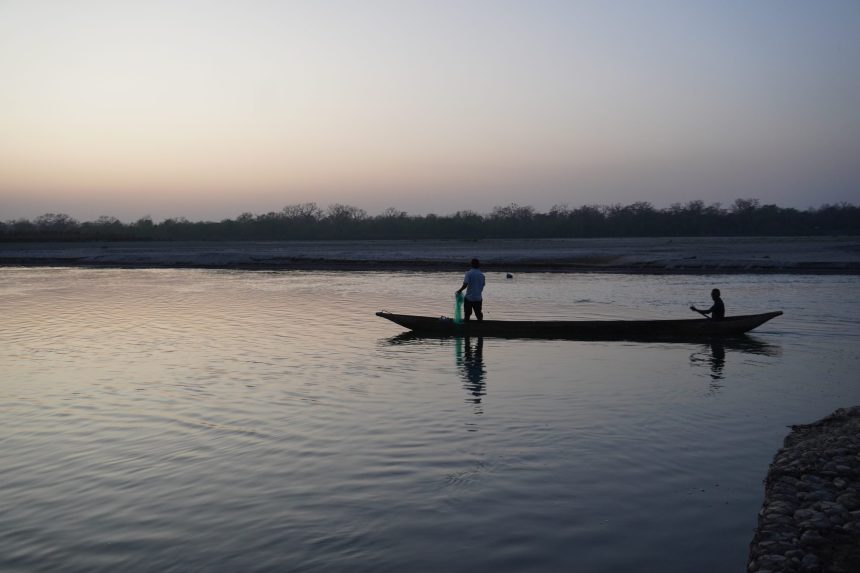
The area surrounding Bardia National Park has certainly developed over the years. With the coming of the road between the Mahendra Highway and the park headquarters at Thakurdwara, you would expect tourism to have taken off. Keep reading!
Royal Privilege
Let us recall that Bardia is the largest national park in the lowland area of Nepal, being 968 km2 with a buffer zone of 327 km2. Having only become a national park in 1988, renamed from Karnali Wildlife Reserve in 1976, let’s also be reminded that this was once a royal hunting reserve. One can only imagine how privileged it must felt to be among the first to visit the forests of lowland Nepal and with the prospect of bagging a tiger. This barbaric practice involved not only Nepali royals but British ones from the late 1800’s until, basically, the First World War. Fortunately, time has moved on and the only shooting visitors do today is with a camera.

Mammals, Birds and that Rare Species – The Tourist
Bardia has always been home to the largest Royal Bengal Tiger population in Nepal, and this fact holds true today. With local villages lying entirely outside the boundaries of the park, there were few stories of conflict between tigers and humans in those early days. As the local population of Tharu communities traditionally built, and continue to build, their homes with the long, thick grasses and bamboos cut from the forests, there were incidents of people being attacked by wildlife while in the forest and grasslands of the park. We will come back to this point later.
With its huge number of different varieties of birds, Bardia has always been a bird-watchers’ paradise. Between the forest areas, the grasslands and the lush riverbanks, hundreds of local and migratory birds make their home in this excellent landscape. As the Karnali River and Babai River run through the park, they provide water for all the wildlife and bird life, as well as home for Gangetic River Dolphins, gharial and mugger crocodiles. There is nothing quite like sitting quietly at dusk watching animals come down to drink! The park is made up of forest lands and grasslands, the latter providing the ideal place to spot larger wildlife, while the forests are full of monkeys, birds and the more shy mammals. Despite One-Horned Asian Rhinoceros being translocated from Chitwan National Park as early as 1986, I can say I never saw any in Bardia during those few years covered in this article (1995-2000). Tiger Top Karnali Lodge was established in 1988 and held a unique position in that it was the first to bring tourists to this remote part of the country. The majority of its visitors would have flown into Nepalgunj airport and been transferred the three plus hours from Nepalgunj to Tiger Tops on their own jeeps.
By 1995 the first local, almost like a home stay, guest house was joined by a second guest house (mine!) – both situated on the border of the park, within walking distance of the park entrance. It looked like Bardia was finally on the map!
But it wasn’t. Visitors were few between 1995 and the new millennium. What visitors that did make it there were mainly Western travelers coming from India via the Bambassa border in the far west of Nepal. Plus, a few daring International Non-governmental Organization (INGO) staff who most likely knew about the area through their work with poor, remote communities.

Caught on Camera
In order to try and increase the numbers of visitors, I hired someone to come and film what was on offer in terms of wildlife, nature, and accommodation. Our videographer took numerous trips into the park in order to capture some of the beauty and essence of the area, with the plan to show the footage to travel and trekking agencies to demonstrate there was more wildlife in Nepal than that found in Chitwan National Park or up in the mountains!
In Kathmandu, it soon became clear that agencies did not know about Bardia National Park – much as I suspected. Yes, it looked beautiful, but why send clients so far when Chitwan National Park was much closer and more established?
At first only the larger rafting companies had even heard of Bardia. Ultimate Descents ran trips down the Karnali and yes, sometimes their clients would make their own way into Bardia from the ending point at Chisapani on the Mahendra Highway. A few clients even booked into Tiger Tops. So, it was the likes of those rafting companies who were excited to know there was now available less expensive accommodation options, complete with trained jungle guides.
Slowly a few agents took the plunge and started to advertise Bardia, but I would say it took another four years before you could say there were enough visitors to the park to make running a guest house truly viable.
Bardia in Print!
The big turning point came when Lonely Planet came to visit. We were extremely excited to see the outcome of their introduction to Bardia National Park. Sure enough, in 1997 the long- awaited issue containing details of Bardia, how to get there, and accommodation available, came out and the reaction was stunning.
From April 1995 to August 1996 we saw 42 guests at our guest house, mainly those travelers coming from India as mentioned before. In the spring season alone of 1997 we welcomed 250 guests. This despite two new guests houses being opened up by ex-staff. It also helped that now, not only had Thakurdwara received its own PCO (public communication office aka a telephone), my guest house also had its own telephone line! Earlier we hiked up to Tiger Tops to use their satellite phone to make any calls. Between the new telephone, bread being made in a small town a few miles away along the highway and delivered to the guest house, and ice being available from the same town (in blocks to store bottles of cold drinks on in the summer), we felt we were quite the big time establishment!
Taking a leaf out of Chitwan’s book, we arranged culture shows and visits to local villages for our guests. The indigenous inhabitants of Bardia are Tharu, whose origins are foggy, but it is widely believed they migrated from India during the Mughal wars. With their unique life style, bamboo and grass homes, and traditional dress, tourists loved to visit the villages. Also, a highlight of any stay was a culture dance evening.
Animal / Human Conflict
In these early years, the local communities were quite small and although there was conflict between humans and wildlife they were not as frequent as today. As mentioned, people would go into the park to collect building materials and foods such as mushrooms or fodder for livestock. While busy gathering, it may be that people inadvertently got between a mother and its child or surprised an animal in its territory.
While tigers have little reason to leave their habitat unless provoked, leopards were more likely to come into the village, and guest houses, at night. I know of several puppies that were taken and several dogs injured while protecting their kin and their human family’s livestock and property.
Elephants
Being that Bardia is part of a corridor for migratory elephants coming up from India, there were certain times of the year where we saw more activity. When the rice or wheat was ready to harvest, wild elephants would enter the fields for a free dinner. Much to the distress of the locals who would go out to chase them away with fire torches. I recall that during the first year we were running the guest house, we lit fires around the compound area during the night. But after that first year, we learned that the elephants were not interested in us, they were after that delicious meal of wheat or rice! Unfortunately for the locals who, once harvested, would store huge sacks of grain in their homes, elephants often followed their sensitive trucks to those homes. The result was often damage to the building and grain stock.
Next to our guest house was the King Mahendra Trust, now know as the National Trust for Nature Conservation, which is an autonomous, not for profit organization working in the field of conservation in Nepal. It had several elephants to enable its staff to access the more remote areas, and thicker jungles of the park. These domestic elephants were female. They certainly attracted the attention of the male wild elephants! I do not know for a fact if there were any unwanted calves being born but it sure made for an interesting night-time soundbite for us next door.
This all made for quite an exciting time for visitors, who several times during that first year of our learning curve, were woken up in the middle of the night to both be on guard and to witness elephants being chased around the next door fields. The only serious incident we had during these early years was when a British guest and our most experienced jungle guide were coming back from a jungle walk. It was dusk and they were outside of the park on the rough road back to the guest house when they were attacked by a stray elephant. Where the elephant was going it is not clear, but I suspect he may have been on his way to visit the females at the Trust. The tourist jumped into a ditch and managed to avoid injury while our guide was tusked in the thigh. As it turned out the tourist was an accident and emergency (A&E) room nurse, so he also went on the jeep taking our guide to hospital in Nepalgunj. Fortunately, there was no serious or lasting damage to the guide and they both returned in the morning. Our guest told us that on seeing his guide was injured, his professional training kicked in and he became calm and efficient. Once he got the news from the doctors that there was no major damage done, he told us he totally collapsed with post-traumatic stress. Some months later I received a letter from him. He had not told anyone back home about this incident (no internet in those days) but when he returned home, his girlfriend gave him a present. An earring in the shape of an elephant head!

Increasing Human Population
Over the years since 2000, the local population has grown as has the number of visitors and the corresponding number of hotels and guest houses. During my early days in Bardia, the local communities had little access to education and very few even spoke Nepali. But with more access to the outside via the road link and visitors from both overseas and Nepal, the locals began to see there may be more to Bardia National Park than the grass required to replace their thatched roofs and feed their livestock.
Some went on to train as jungle guides while others obtained other jobs in guest houses, such as cooks and waiters. And quite a few went on to establish accommodation for visitors through creating homestays in their own homes.
Coming Up
Coming in the next article we will take a look at homestays in Bardia, how they developed and are they available in other parts of the country? Spoiler alert – yes they are!